Evaluation of three stocking densities for black carachama (Pterygoplichthys pardalis) during the fattening phase
DOI:
https://doi.org/10.55873/k6y3we60Keywords:
aquaculture, water quality, black carachama, stocking density, economic profitabilityAbstract
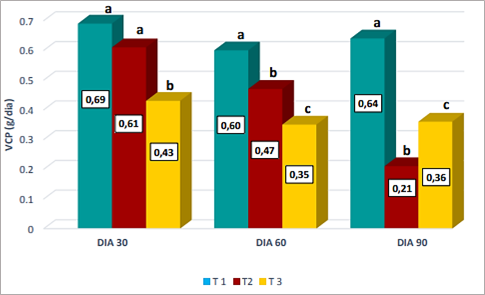
Stocking density can affect productive performance, profitability, and rearing conditions for fish. The objective was to evaluate the effect of three stocking densities on productive and economic performance as well as water quality during the grow-out phase of the black *carachama* (*Pterygoplichthys pardalis*). A total of 1,800 fish were used, with an initial average weight of 60.82 ± 5.00 g and a standard length of 14.88 ± 5.00 cm. A completely randomized design was applied with three treatments: 10 (T1), 15 (T2), and 20 fish/m² (T3), with four replicates per treatment. The density of 10 fish/m² yielded the best results, with a weight growth rate of 0.64 g/day, a length growth rate of 0.04 cm/day, and 100% survival. This treatment also achieved a net profit of S/ 5.16 per kilogram and an economic merit of 53%. Physicochemical water parameters were similar across the evaluated densities, with the exception of pH. It is concluded that a density of 10 fish/m² favors the productive and economic performance of the black carachama during the grow-out phase without causing significant alterations to water quality.
References
Armbruster, J. W. (2004). Phylogenetic relationships of the suckermouth armoured catfishes (Loricariidae) with emphasis on the Hypostominae and the Ancistrinae. Zoological Journal of the Linnean Society, 141(1), 1–80. https://doi.org/10.1111/j.1096-3642.2004.00109.x
Balladares Merma, D., & Lezama Cana, L. (2017). Evaluación del efecto de suministro de alimento balanceado sobre el desarrollo de la carachama(liposarcus sp.) en estado juvenil criados en sistema de estanque. Universidad Nacional Amazónica de Madre de Dios.
Barba, E. (2014). Abundancia del plecos (Pterygoplichthys pardalis) en sistemas lagunares y ribereños de la cuenca del Usumacinta, Balancán, Tabasco, México. In A. M. Low Pfeng, P. A. Quijón, & E. M. Peters Recagno (Eds.), Especies invasoras acuáticas: casos de estudio en ecosistemas de México. Secretaría de Medio Ambiente y Recursos Naturales: Instituto Nacional de Ecología y Cambio Climático: University of Prince Edward Island.
Barros, F. J. T. de, Bahia, I. R. da S. L., Nascimento, T. P., Moura, M. C. de S., Torres, R. A., Pereira, T. da S., & Sousa, L. M. de. (2024). Effect of Stocking Density on the Growth of the Endangered Amazonian Fish Hypancistrus zebra (Siluriformes: Loricariidae). Aquatic Conservation: Marine and Freshwater Ecosystems, 34(9). https://doi.org/10.1002/aqc.4256
Castañeda, D., Flórez, Y. C., Luz, S., & Chacón, O. (2019). Pez diablo (Pterygoplichthys pardalis): ¿Una plaga con potencial para el aprovechamiento agroindustrial?
Ellis, T., North, B., Scott, A. P., Bromage, N. R., Porter, M., & Gadd, D. (2002). The relationships between stocking density and welfare in farmed rainbow trout. Journal of Fish Biology, 61(3), 493–531. https://doi.org/10.1111/j.1095-8649.2002.tb00893.x
Fiestas Ríos, J. J. (2016). Efecto de dietas a base de microalgas y balanceados en el crecimiento y supervivencia de post larvas de Pterygoplichthys pardalis (Castelnau, 1855) “carachama negra” en cautiverio. Universidad Nacional del Santa.
FONDEPES. (2018). Manual de cultivo de gamitana en ambientes convencionales.
García Dávila, C., Sánchez Riveiro, H., Flores Silva, M. A., Mejía de Loayza, E., Angulo Chávez, C., Castro Ruiz, D., Estivals, G., García Vásquez, A., Nolorbe Payahua, C., Vargas Dávila, G., Núñez, J., Mariac, C., Duponchelle, F., & Renno, J.-F. (2018). Peces de consumo de la Amazonía peruana (Instituto de Investigaciones de la Amazonía Peruana (ed.)).
Guerra Flores, H. (2006). Cultivando peces amazónicos (Instituto de Investigaciones de la Amazonía Peruana (ed.)).
Jimenez-Segura, L. F., Alvarez Bustamante, J., Eneida Ochoa, L., Loaiza, A., Londoño, J. P., Restrepo Santamaria, D., Aguirre, K., Hernandez-Serna, A., Corrêa, D., & Jaramillo, U. (2014). Guía Ilustrada Peces cañón del río Porce. Región de los Andes de Colombia (Universida). Universidad de Antioquia, Herbario Universidad de Antioquia - Medellín, Colombia.
Kubitza, F. (2003). Qualidade da água no cultivo de peixes e camarões.
Li, L., Shen, Y., Yang, W., Xu, X., & Li, J. (2021). Effect of different stocking densities on fish growth performance: A meta-analysis. Aquaculture, 544, 737152. https://doi.org/10.1016/j.aquaculture.2021.737152
Mendoza, R., Contreras, S., Ramírez, C., Koleff, P., Álvarez, P., & Aguilar, V. (2007). Los peces diablo: Especies invasoras de alto impacto. Biodiversitas, 70, 1–5.
Nuñes Bustamante, W. (2017). Efecto de cuatro densidades de cultivo de oreochromis niloticus (tilapia) en fase de crecimiento, sobre los parámetros bioeconómicos. Universidad Nacional Agraria de la Selva.
Oké, V., & Goosen, N. J. (2019). The effect of stocking density on profitability of African catfish (Clarias gariepinus) culture in extensive pond systems. Aquaculture, 507, 385–392. https://doi.org/10.1016/j.aquaculture.2019.04.043
Ríos Isern, E. (2021). Calidad de agua en el cultivo de organismos acuáticos amazónicos. Universidad Nacional De La Amazonia Peruana.
Rodríguez, H., & Anzola, E. (2001). La calidad del agua y la productividad de un estanque en acuicultura. In Fundamentos de acuicultura continental. Instituto Nacional de Pesca y Acuicultura.
Saldaña Arévalo, M. A. (2015). Reproducción en cautiverio de la “Carachama negra” Liposarcus pardalis (Castelnau, 1855) en el centro de investigación "Carlos Miguel Castañeda Ruíz, IIAP San Martín - Perú. Universidad Nacional de la Amazonia Peruana.
Vilca Carhuapoma, E. (2019). Rendimiento de alimentos balanceados comerciales en el crecimiento de Pterygoplichthys sp. “carachama negra”, Madre de Dios, 2018 - 2019. Universidad Nacional de San Cristóbal de Huamanga.
Downloads
Published
Issue
Section
License
Copyright (c) 2026 Segundino Benito Camones-Yanac, Homero Josué Gómez-Matos , Olger Jacinto Mochcco-Muñoz

This work is licensed under a Creative Commons Attribution 4.0 International License.