Evaluation of the effect of three protein supplements on the pollinating performance of Apis mellifera
DOI:
https://doi.org/10.55873/9r7z5g77Keywords:
apicultural nutrition, Apis mellifera, colony development, protein supplements, supplementary feedingAbstract
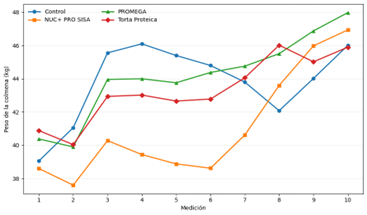
The effects of three commercial supplements on the development of Apis mellifera colonies were evaluated at Fundo Agroinca, La Joya, Arequipa. A field trial was conducted with four treatments: control, NUC+ PRO SISA, PROMEGA, and Protein Patty, complemented by proximate analysis of the supplements. During the experimental period, colony weight, number of occupied frames, and number of brood frames were recorded. PROMEGA showed the best overall performance, with the highest mean values for colony weight, occupied frames, and brood frames. NUC+ PRO SISA showed an intermediate response, whereas the Protein Patty exhibited a more limited performance in the population-related indicators. Proximate analysis revealed differences in the nutritional composition of the products. Overall, the findings indicate that colony response depends on the nutritional characteristics of the supplement used and its performance under local field conditions.
References
Ansaloni, L. S., Kristl, J., Domingues, C. E. C., & Gregorc, A. (2025). An Overview of the Nutritional Requirements of Honey Bees (Apis mellifera Linnaeus, 1758). Insects, 16(1), 97. https://doi.org/10.3390/insects16010097
Brodschneider, R., & Crailsheim, K. (2010). Nutrition and health in honey bees. Apidologie, 41(3), 278–294. https://doi.org/10.1051/apido/2010012
Capela, N., Dupont, Y. L., Rortais, A., Sarmento, A., Papanikolaou, A., Topping, C. J., Arnold, G., Pinto, M. A., Rodrigues, P. J., More, S. J., Tosi, S., Alves, T. S., & Sousa, J. P. (2023). High accuracy monitoring of honey bee colony development by a quantitative method. Journal of Apicultural Research, 62(4), 741–750. https://doi.org/10.1080/00218839.2022.2098899
DeGrandi-Hoffman, G., Chen, Y., Huang, E., & Huang, M. H. (2010). The effect of diet on protein concentration, hypopharyngeal gland development and virus load in worker honey bees (Apis mellifera L.). Journal of Insect Physiology, 56(9), 1184–1191. https://doi.org/10.1016/j.jinsphys.2010.03.017
DeGrandi-Hoffman, G., Wardell, G., Ahumada-Segura, F., Rinderer, T., Danka, R., & Pettis, J. (2008). Comparisons of pollen substitute diets for honey bees: consumption rates by colonies and effects on brood and adult populations. Journal of Apicultural Research, 47(4), 265–270. https://doi.org/10.1080/00218839.2008.11101473
Di Pasquale, G., Salignon, M., Le Conte, Y., Belzunces, L. P., Decourtye, A., Kretzschmar, A., Suchail, S., Brunet, J.-L., & Alaux, C. (2013). Influence of Pollen Nutrition on Honey Bee Health: Do Pollen Quality and Diversity Matter? PLoS ONE, 8(8), e72016. https://doi.org/10.1371/journal.pone.0072016
García-Vicente, E. J., Martín, M., Rey-Casero, I., Pérez, A., Martín, J., García, A., Alonso, J. M., & Risco, D. (2024). Effects of feeding with a protein liquid supplement on productivity, mortality and health of Apis mellifera hives in southwestern Spain. Research in Veterinary Science, 169, 105173. https://doi.org/10.1016/j.rvsc.2024.105173
Groeneveld, J., Odemer, R., & Requier, F. (2024). Brood indicators are an early warning signal of honey bee colony loss—a simulation-based study. PLOS ONE, 19(5), e0302907. https://doi.org/10.1371/journal.pone.0302907
Harris, C., Balfour, N. J., & Ratnieks, F. L. W. (2024). Seasonal variation in the general availability of floral resources for pollinators in northwest Europe: A review of the data. Biological Conservation, 298, 110774. https://doi.org/10.1016/j.biocon.2024.110774
Hendriksma, H. P., Pachow, C. D., & Nieh, J. C. (2019). Effects of essential amino acid supplementation to promote honey bee gland and muscle development in cages and colonies. Journal of Insect Physiology, 117, 103906. https://doi.org/10.1016/j.jinsphys.2019.103906
Hoover, S. E., Ovinge, L. P., & Kearns, J. D. (2022). Consumption of Supplemental Spring Protein Feeds by Western Honey Bee (Hymenoptera: Apidae) Colonies: Effects on Colony Growth and Pollination Potential. Journal of Economic Entomology, 115(2), 417–429. https://doi.org/10.1093/jee/toac006
K.S. Delaplane, J.J.M. van der Steen, E. G.-N. (2013). Standard methods for estimating strength parameters of Apis mellifera colonies. Journal of Apicultural Research, 1–12. https://doi.org/10.3896/IBRA.1.52.1.03
Klein, A.-M., Vaissière, B. E., Cane, J. H., Steffan-Dewenter, I., Cunningham, S. A., Kremen, C., & Tscharntke, T. (2007). Importance of pollinators in changing landscapes for world crops. Proceedings of the Royal Society B: Biological Sciences, 274(1608), 303–313. https://doi.org/10.1098/rspb.2006.3721
Lamontagne-Drolet, M., Samson-Robert, O., Giovenazzo, P., & Fournier, V. (2019). The Impacts of Two Protein Supplements on Commercial Honey Bee ( Apis mellifera L.) Colonies. Journal of Apicultural Research, 58(5), 800–813. https://doi.org/10.1080/00218839.2019.1644938
Naug, D. (2009). Nutritional stress due to habitat loss may explain recent honeybee colony collapses. Biological Conservation, 142(10), 2369–2372. https://doi.org/10.1016/j.biocon.2009.04.007
Noordyke, E. R., & Ellis, J. D. (2021). Reviewing the Efficacy of Pollen Substitutes as a Management Tool for Improving the Health and Productivity of Western Honey Bee (Apis mellifera) Colonies. Frontiers in Sustainable Food Systems, 5. https://doi.org/10.3389/fsufs.2021.772897
Peirson, M., Ibrahim, A., Ovinge, L. P., Hoover, S. E., Guarna, M. M., Melathopoulos, A., & Pernal, S. F. (2024). The effects of protein supplementation, fumagillin treatment, and colony management on the productivity and long-term survival of honey bee (Apis mellifera) colonies. PLOS ONE, 19(3), e0288953. https://doi.org/10.1371/journal.pone.0288953
Potts, S. G., Imperatriz-Fonseca, V., Ngo, H. T., Aizen, M. A., Biesmeijer, J. C., Breeze, T. D., Dicks, L. V., Garibaldi, L. A., Hill, R., Settele, J., & Vanbergen, A. J. (2016). Safeguarding pollinators and their values to human well-being. Nature, 540(7632), 220–229. https://doi.org/10.1038/nature20588
Quinlan, G. M., & Grozinger, C. M. (2023). Honey bee nutritional ecology: From physiology to landscapes (pp. 289–345). https://doi.org/10.1016/bs.aiip.2023.01.003
Zheng, B., Wu, Z., & Xu, B. (2014). The Effects of Dietary Protein Levels on the Population Growth, Performance, and Physiology of Honey Bee Workers During Early Spring. Journal of Insect Science, 14(1). https://doi.org/10.1093/jisesa/ieu053
Downloads
Published
Issue
Section
License
Copyright (c) 2026 Valeria Belén Millones-Abarca , Verónica Marianella Román-Coyla

This work is licensed under a Creative Commons Attribution 4.0 International License.