Efecto de la ozonización sobre la carga bacteriana del aire en ambientes de procesamiento de semen porcino
DOI:
https://doi.org/10.55873/2snssr92Palabras clave:
desinfección, aerobios mesófilos, coliformes, Escherichia coli, bioseguridadResumen
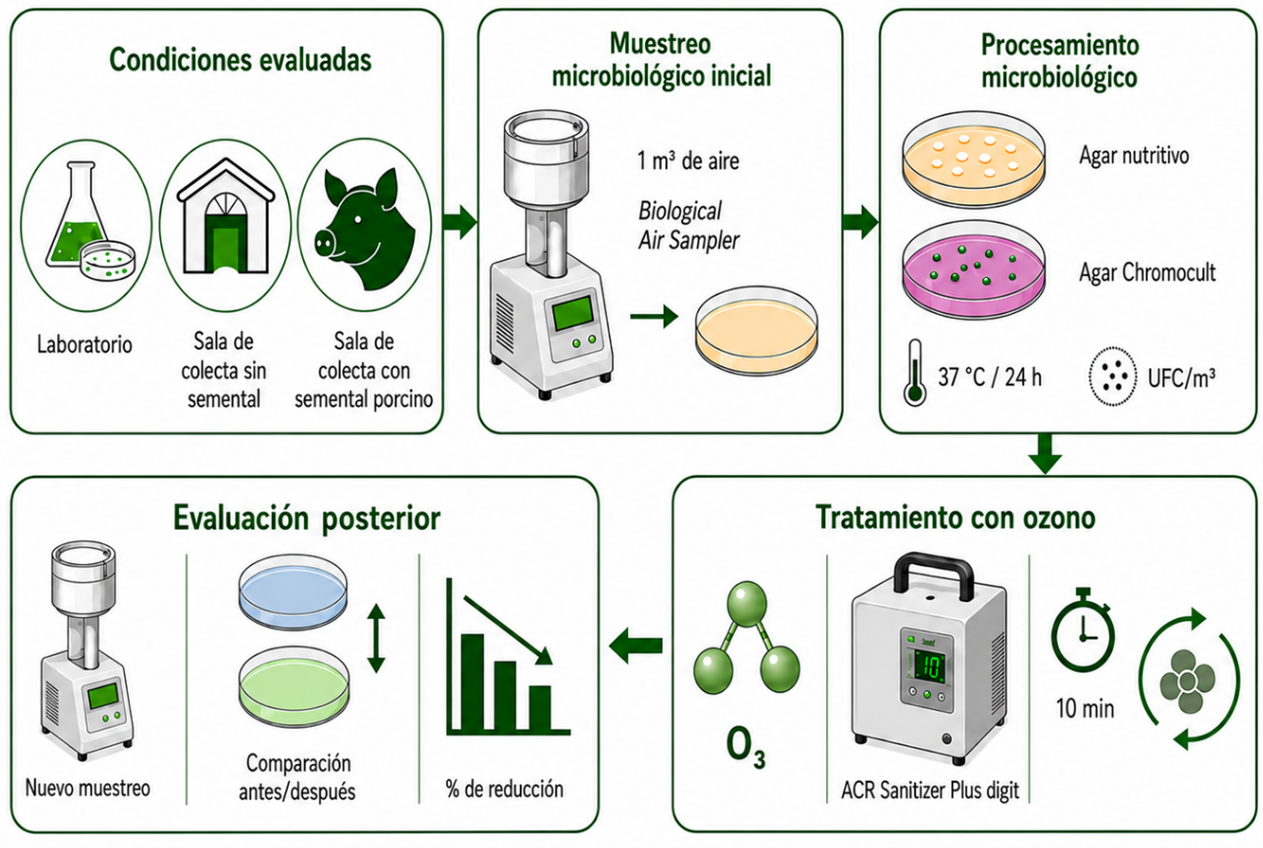
La calidad microbiológica del aire es relevante en el procesamiento de semen porcino, donde los microorganismos pueden comprometer las condiciones higiénicas del proceso. El objetivo fue determinar el efecto del ozono sobre la carga bacteriana del aire en ambientes de procesamiento de semen porcino. Se evaluaron el laboratorio y la sala de colecta, en ausencia y presencia del semental, mediante muestreo por impactación de 1 m³ de aire antes y después de una ozonización de 10 min, con recuento de aerobios mesófilos totales, coliformes totales y Escherichia coli. Los aerobios mesófilos disminuyeron de 210 a 74, de 1120 a 162 y de 1736 a 202 UFC/m³, con reducciones de 64,8, 85,5 y 88,4 %, respectivamente, y un promedio de 79,6 %, sin detección de Escherichia coli ni coliformes totales. La ozonización mostró potencial como medida complementaria de control microbiológico ambiental dentro de las prácticas de higiene y bioseguridad.
Referencias
Augustin, K., Tanuwidjaja, I., Kovaček, I., Majić, I., Luković, Z., & Mrkonjic Fuka, M. (2021). Microbiological analysis of indoor and outdoor air on a pig farm in Slavonia. Journal of Central European Agriculture, 22(2), 260–268. https://doi.org/10.5513/JCEA01/22.2.3143
Ciornei, Ş., Drugociu, D., Ciornei, L. M., Mareş, M., & Roşca, P. (2021). Total Aseptization of Boar Semen, to Increase the Biosecurity of Reproduction in Swine. Molecules, 26(20), 6183. https://doi.org/10.3390/molecules26206183
Contreras, M. J., Núñez-Montero, K., Bruna, P., García, M., Leal, K., Barrientos, L., & Weber, H. (2022). Bacteria and Boar Semen Storage: Progress and Challenges. Antibiotics, 11(12), 1796. https://doi.org/10.3390/antibiotics11121796
Costinar, L., Herman, V., Pitoiu, E., Iancu, I., Degi, J., Hulea, A., & Pascu, C. (2022). Boar Semen Contamination: Identification of Gram-Negative Bacteria and Antimicrobial Resistance Profile. Animals, 12(1), 43. https://doi.org/10.3390/ani12010043
Epelle, E. I., Emmerson, A., Nekrasova, M., Macfarlane, A., Cusack, M., Burns, A., Mackay, W., & Yaseen, M. (2022). Microbial Inactivation: Gaseous or Aqueous Ozonation? Industrial & Engineering Chemistry Research, 61(27), 9600–9610. https://doi.org/10.1021/acs.iecr.2c01551
Epelle, E. I., Macfarlane, A., Cusack, M., Burns, A., Okolie, J. A., Vichare, P., Rolland, L., & Yaseen, M. (2023). Ozone Decontamination of Medical and Nonmedical Devices: An Assessment of Design and Implementation Considerations. Industrial & Engineering Chemistry Research, 62(10), 4191–4209. https://doi.org/10.1021/acs.iecr.2c03754
Gączarzewicz, D., Udała, J., Piasecka, M., Błaszczyk, B., & Stankiewicz, T. (2016). Bacterial Contamination of Boar Semen and its Relationship to Sperm Quality Preserved in Commercial Extender Containing Gentamicin Sulfate. Polish Journal of Veterinary Sciences, 19(3), 451–459. https://doi.org/10.1515/pjvs-2016-0057
Kraemer, J. G., Aebi, S., Oppliger, A., & Hilty, M. (2019). The Indoor-Air Microbiota of Pig Farms Drives the Composition of the Pig Farmers’ Nasal Microbiota in a Season-Dependent and Farm-Specific Manner. Applied and Environmental Microbiology, 85(9). https://doi.org/10.1128/AEM.03038-18
Maheux, A. F., Huppé, V., Boissinot, M., Picard, F. J., Bissonnette, L., Bernier, J.-L. T., & Bergeron, M. G. (2008). Analytical limits of four β-glucuronidase and β-galactosidase-based commercial culture methods used to detect Escherichia coli and total coliforms. Journal of Microbiological Methods, 75(3), 506–514. https://doi.org/10.1016/j.mimet.2008.08.001
Martinelli, M., Giovannangeli, F., Rotunno, S., Trombetta, C., & Montomoli, E. (2017). Water and air ozone treatment as an alternative sanitizing technology. J Prev Med Hyg, 58(1), E48–E52. https://pmc.ncbi.nlm.nih.gov/articles/PMC5432778/
Masotti, F., Vallone, L., Ranzini, S., Silvetti, T., Morandi, S., & Brasca, M. (2019). Effectiveness of air disinfection by ozonation or hydrogen peroxide aerosolization in dairy environments. Food Control, 97, 32–38. https://doi.org/10.1016/j.foodcont.2018.10.022
Moccia, G., De Caro, F., Pironti, C., Boccia, G., Capunzo, M., Borrelli, A., & Motta, O. (2020). Development and Improvement of an Effective Method for Air and Surfaces Disinfection with Ozone Gas as a Decontaminating Agent. Medicina, 56(11), 578. https://doi.org/10.3390/medicina56110578
Neves, E. S., Ng, C. T., Pek, H. Bin, Goh, V. S. L., Mohamed, R., Osman, S., Ng, Y. K., Kadir, S. A., Nazeem, M., She, A., Sim, G., Aik, J., Ng, L. C., Octavia, S., Fang, Z., Wong, J. C. C., & Setoh, Y. X. (2023). Field trial assessing the antimicrobial decontamination efficacy of gaseous ozone in a public bus setting. Science of The Total Environment, 876, 162704. https://doi.org/10.1016/j.scitotenv.2023.162704
Nitsche-Melkus, E., Bortfeldt, R., Jung, M., & Schulze, M. (2020). Impact of hygiene on bacterial contamination in extended boar semen: An eight-year retrospective study of 28 European AI centers. Theriogenology, 146, 133–139. https://doi.org/10.1016/j.theriogenology.2019.11.031
Piletić, K., Linšak, D. T., Kovač, B., Mežnarić, S., Repustić, M., Radmanović-Skrbić, M., & Gobin, I. (2022). Ozone disinfection efficiency against airborne microorganisms in hospital environment: a case study. Archives of Industrial Hygiene and Toxicology, 73(4), 270–276. https://doi.org/10.2478/aiht-2022-73-3651
Sancho, S., Briz, M., Yeste, M., Bonet, S., & Bussalleu, E. (2017). Effects of the antimicrobial peptide protegrine 1 on sperm viability and bacterial load of boar seminal doses. Reproduction in Domestic Animals, 52(S4), 69–71. https://doi.org/10.1111/rda.13061
Schulze, M., Ammon, C., Rüdiger, K., Jung, M., & Grobbel, M. (2015). Analysis of hygienic critical control points in boar semen production. Theriogenology, 83(3), 430–437. https://doi.org/10.1016/j.theriogenology.2014.10.004
Schulze, M., Czirják, G. Á., Müller, K., Bortfeldt, R., Jung, M., & Jakop, U. (2019). Antibacterial defense and sperm quality in boar ejaculates. Journal of Reproductive Immunology, 131, 13–20. https://doi.org/10.1016/j.jri.2018.11.001
Tvrdá, E., Bučko, O., Rojková, K., Ďuračka, M., Kunová, S., Kováč, J., Benko, F., & Kačániová, M. (2021). The Efficiency of Selected Extenders against Bacterial Contamination of Boar Semen in a Swine Breeding Facility in Western Slovakia. Animals, 11(11), 3320. https://doi.org/10.3390/ani11113320
Waberski, D., Riesenbeck, A., Schulze, M., Weitze, K. F., & Johnson, L. (2019). Application of preserved boar semen for artificial insemination: Past, present and future challenges. Theriogenology, 137, 2–7. https://doi.org/10.1016/j.theriogenology.2019.05.030
Xue, W., Macleod, J., & Blaxland, J. (2023). The Use of Ozone Technology to Control Microorganism Growth, Enhance Food Safety and Extend Shelf Life: A Promising Food Decontamination Technology. Foods, 12(4), 814. https://doi.org/10.3390/foods12040814
Descargas
Publicado
Número
Sección
Licencia
Derechos de autor 2026 Veronica Marianella Roman-Coyla , Elias David Esquicha-Larico

Esta obra está bajo una licencia internacional Creative Commons Atribución 4.0.