Resistencia y adaptación evolutiva de los murciélagos frente a la rabia
DOI:
https://doi.org/10.55873/xxkanw63Palabras clave:
adaptación evolutiva, Lyssavirus, murciélagos, rabia, tolerancia viralResumen
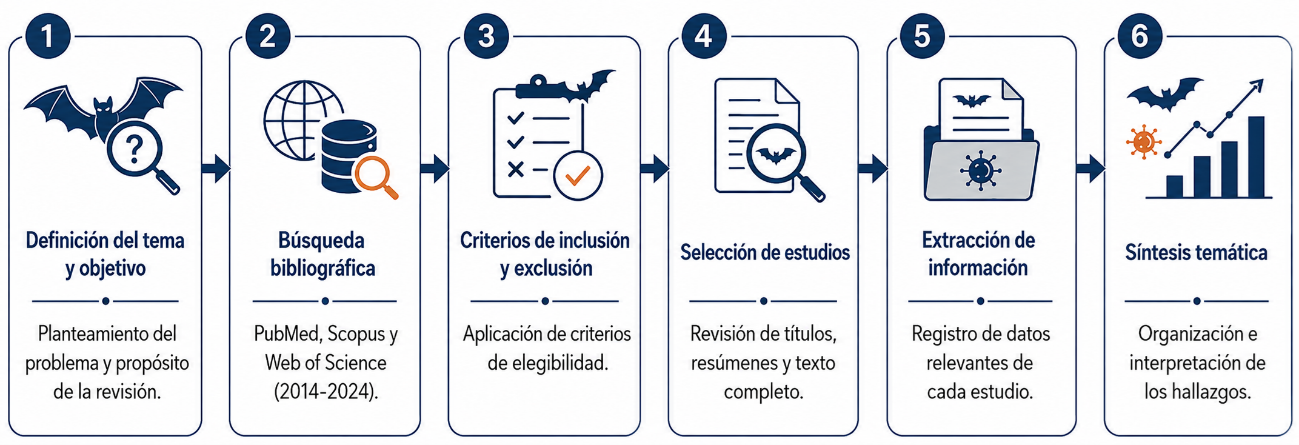
La rabia continúa siendo una zoonosis de alta letalidad en la que los murciélagos desempeñan un papel relevante como reservorios, particularmente Desmodus rotundus en América Latina. El objetivo de esta revisión fue analizar la evidencia científica sobre los mecanismos de resistencia, tolerancia y adaptación evolutiva de los murciélagos frente al virus de la rabia y Lyssavirus relacionados. Se realizó una revisión integrativa de 25 artículos publicados entre 2014 y 2024, recuperados de PubMed, Scopus y Web of Science. Los estudios fueron organizados según la interacción hospedador-virus, mecanismos inmunológicos, adaptaciones genéticas y evolutivas, e implicaciones epidemiológicas. La evidencia mostró que los murciélagos no presentan una resistencia absoluta a la rabia, sino respuestas variables que incluyen susceptibilidad, supervivencia posterior a la exposición y tolerancia. Entre los mecanismos más relevantes destacaron las vías de interferón, la regulación de la inflamación y modificaciones evolutivas en genes vinculados con la inmunidad antiviral. Estos procesos difieren entre especies y no pueden generalizarse a todos los quirópteros. Se concluye que comprender esta diversidad inmunológica y evolutiva resulta fundamental para mejorar la vigilancia y el control de la rabia desde un enfoque One Health.
Referencias
Ahn, M., Anderson, D. E., Zhang, Q., Tan, C. W., Lim, B. L., Luko, K., Wen, M., Chia, W. N., Mani, S., Wang, L. C., Ng, J. H. J., Sobota, R. M., Dutertre, C.-A., Ginhoux, F., Shi, Z.-L., Irving, A. T., & Wang, L.-F. (2019). Dampened NLRP3-mediated inflammation in bats and implications for a special viral reservoir host. Nature Microbiology, 4(5), 789–799. https://doi.org/10.1038/s41564-019-0371-3
Ahn, M., Cui, J., Irving, A. T., & Wang, L.-F. (2016). Unique Loss of the PYHIN Gene Family in Bats Amongst Mammals: Implications for Inflammasome Sensing. Scientific Reports, 6(1), 21722. https://doi.org/10.1038/srep21722
Bakker, K. M., Rocke, T. E., Osorio, J. E., Abbott, R. C., Tello, C., Carrera, J. E., Valderrama, W., Shiva, C., Falcon, N., & Streicker, D. G. (2019). Fluorescent biomarkers demonstrate prospects for spreadable vaccines to control disease transmission in wild bats. Nature Ecology & Evolution, 3(12), 1697–1704. https://doi.org/10.1038/s41559-019-1032-x
Benavides, J. A., Velasco-Villa, A., Godino, L. C., Satheshkumar, P. S., Nino, R., Rojas-Paniagua, E., Shiva, C., Falcon, N., & Streicker, D. G. (2020). Abortive vampire bat rabies infections in Peruvian peridomestic livestock. PLOS Neglected Tropical Diseases, 14(6), e0008194. https://doi.org/10.1371/journal.pntd.0008194
Caraballo, D. A., Vico, M. L., Piccirilli, M. G., Hirmas Riade, S. M., Russo, S., Martínez, G., Beltrán, F. J., & Cisterna, D. M. (2024). Bat Rabies in the Americas: Is Myotis the Main Ancestral Spreader? Viruses, 16(8), 1302. https://doi.org/10.3390/v16081302
Cárdenas-Canales, E. M., Gigante, C. M., Greenberg, L., Velasco-Villa, A., Ellison, J. A., Satheshkumar, P. S., Medina-Magües, L. G., Griesser, R., Falendysz, E., Amezcua, I., Osorio, J. E., & Rocke, T. E. (2020). Clinical Presentation and Serologic Response during a Rabies Epizootic in Captive Common Vampire Bats (Desmodus rotundus). Tropical Medicine and Infectious Disease, 5(1), 34. https://doi.org/10.3390/tropicalmed5010034
Casagrande, D. K. A., Favaro, A. B. B. de B. da C., Carvalho, C. de, Picolo, M. R., Hernandez, J. C. B., Lot, M. S., Albas, A., Araújo, D. B., André Pedro, W., & Queiroz, L. H. (2014). Rabies surveillance in bats in Northwestern State of São Paulo. Revista Da Sociedade Brasileira de Medicina Tropical, 47(6), 709–715. https://doi.org/10.1590/0037-8682-0189-2014
Corrêa Scheffer, K., Iamamoto, K., Miyuki Asano, K., Mori, E., Estevez Garcia, A. I., Achkar, S. M., & De Oliveira Fahl, W. (2014). Murciélagos hematófagos como reservorios de la rabia. Revista Peruana de Medicina Experimental y Salud Pública, 31(2). https://doi.org/10.17843/rpmesp.2014.312.51
Fisher, C. R., Streicker, D. G., & Schnell, M. J. (2018). The spread and evolution of rabies virus: conquering new frontiers. Nature Reviews Microbiology, 16(4), 241–255. https://doi.org/10.1038/nrmicro.2018.11
Frantchez, V., & Medina, J. (2018). Rabia: 99,9% mortal, 100% prevenible. REVISTA MEDICA DEL URUGUAY, 34(3). https://doi.org/10.29193/RMU.34.3.5
Hopia, H., Latvala, E., & Liimatainen, L. (2016). Reviewing the methodology of an integrative review. Scandinavian Journal of Caring Sciences, 30(4), 662–669. https://doi.org/10.1111/scs.12327
Jebb, D., Huang, Z., Pippel, M., Hughes, G. M., Lavrichenko, K., Devanna, P., Winkler, S., Jermiin, L. S., Skirmuntt, E. C., Katzourakis, A., Burkitt-Gray, L., Ray, D. A., Sullivan, K. A. M., Roscito, J. G., Kirilenko, B. M., Dávalos, L. M., Corthals, A. P., Power, M. L., Jones, G., … Teeling, E. C. (2020). Six reference-quality genomes reveal evolution of bat adaptations. Nature, 583(7817), 578–584. https://doi.org/10.1038/s41586-020-2486-3
Letko, M., Seifert, S. N., Olival, K. J., Plowright, R. K., & Munster, V. J. (2020). Bat-borne virus diversity, spillover and emergence. Nature Reviews Microbiology, 18(8), 461–471. https://doi.org/10.1038/s41579-020-0394-z
López Ingunza, R., Diaz Olivera, A., Osorio Pretel, V., López Fuentes, M., & Mantari Torpoco, C. (2024). Brote de rabia humana por virus de vampiro (Desmodus rotundus) asociado a mordedura de gato en el departamento de Amazonas, Perú, 2024. Anales de La Facultad de Medicina, 85(2), 225–227. https://doi.org/10.15381/anales.v85i2.27605
Megid, J., Benavides Tala, J. A., Belaz Silva, L. D., Castro Castro, F. F., Ribeiro, B. L. D., Appolinário, C. M., Katz, I. S. S., Scheffer, K. C., Silva, S. R., Rosa, A. R., Barone, G. T., Alves Martorelli, L. F., & de Almeida, M. F. (2021). Serological Surveillance of Rabies in Free-Range and Captive Common Vampire Bats Desmodus rotundus. Frontiers in Veterinary Science, 8. https://doi.org/10.3389/fvets.2021.681423
Meza, D. K., Mollentze, N., Broos, A., Tello, C., Valderrama, W., Recuenco, S., Carrera, J. E., Shiva, C., Falcon, N., Viana, M., & Streicker, D. G. (2022). Ecological determinants of rabies virus dynamics in vampire bats and spillover to livestock. Proceedings of the Royal Society B: Biological Sciences, 289(1982). https://doi.org/10.1098/rspb.2022.0860
Moreno Santillán, D. D., Lama, T. M., Gutierrez Guerrero, Y. T., Brown, A. M., Donat, P., Zhao, H., Rossiter, S. J., Yohe, L. R., Potter, J. H., Teeling, E. C., Vernes, S. C., Davies, K. T. J., Myers, E., Hughes, G. M., Huang, Z., Hoffmann, F., Corthals, A. P., Ray, D. A., & Dávalos, L. M. (2021). Large‐scale genome sampling reveals unique immunity and metabolic adaptations in bats. Molecular Ecology, 30(23), 6449–6467. https://doi.org/10.1111/mec.16027
Papies, J., Sieberg, A., Ritz, D., Niemeyer, D., Drosten, C., & Müller, M. A. (2022). Reduced IFN-ß inhibitory activity of Lagos bat virus phosphoproteins in human compared to Eidolon helvum bat cells. PLOS ONE, 17(3), e0264450. https://doi.org/10.1371/journal.pone.0264450
Perez, D. (2023). CDC Perú emite alerta epidemiológica sobre un caso confirmado de rabia humana urbana en Arequipa. CDC Perú.
Rocha, F., & Dias, R. A. (2020). The common vampire bat Desmodus rotundus (Chiroptera: Phyllostomidae) and the transmission of the rabies virus to livestock: A contact network approach and recommendations for surveillance and control. Preventive Veterinary Medicine, 174, 104809. https://doi.org/10.1016/j.prevetmed.2019.104809
Sarkis, S., Lise, M.-C., Darcissac, E., Dabo, S., Falk, M., Chaulet, L., Neuveut, C., Meurs, E. F., Lavergne, A., & Lacoste, V. (2018). Development of molecular and cellular tools to decipher the type I IFN pathway of the common vampire bat. Developmental & Comparative Immunology, 81, 1–7. https://doi.org/10.1016/j.dci.2017.10.023
Scheben, A., Mendivil Ramos, O., Kramer, M., Goodwin, S., Oppenheim, S., Becker, D. J., Schatz, M. C., Simmons, N. B., Siepel, A., & McCombie, W. R. (2023). Long-Read Sequencing Reveals Rapid Evolution of Immunity- and Cancer-Related Genes in Bats. Genome Biology and Evolution, 15(9). https://doi.org/10.1093/gbe/evad148
Viana, M., Benavides, J. A., Broos, A., Ibañez Loayza, D., Niño, R., Bone, J., da Silva Filipe, A., Orton, R., Valderrama Bazan, W., Matthiopoulos, J., & Streicker, D. G. (2023). Effects of culling vampire bats on the spatial spread and spillover of rabies virus. Science Advances, 9(10). https://doi.org/10.1126/sciadv.add7437
Vicente-Santos, A., Lock, L. R., Allira, M., Dyer, K. E., Dunsmore, A., Tu, W., Volokhov, D. V., Herrera, C., Lei, G.-S., Relich, R. F., Janech, M. G., Bland, A. M., Simmons, N. B., & Becker, D. J. (2023). Serum proteomics reveals a tolerant immune phenotype across multiple pathogen taxa in wild vampire bats. Frontiers in Immunology, 14. https://doi.org/10.3389/fimmu.2023.1281732
Whittemore, R., & Knafl, K. (2005). The integrative review: updated methodology. Journal of Advanced Nursing, 52(5), 546–553. https://doi.org/10.1111/j.1365-2648.2005.03621.x
Xie, J., Li, Y., Shen, X., Goh, G., Zhu, Y., Cui, J., Wang, L.-F., Shi, Z.-L., & Zhou, P. (2018). Dampened STING-Dependent Interferon Activation in Bats. Cell Host & Microbe, 23(3), 297-301.e4. https://doi.org/10.1016/j.chom.2018.01.006
Zhou, P., Tachedjian, M., Wynne, J. W., Boyd, V., Cui, J., Smith, I., Cowled, C., Ng, J. H. J., Mok, L., Michalski, W. P., Mendenhall, I. H., Tachedjian, G., Wang, L.-F., & Baker, M. L. (2016). Contraction of the type I IFN locus and unusual constitutive expression of IFN-α in bats. Proceedings of the National Academy of Sciences, 113(10), 2696–2701. https://doi.org/10.1073/pnas.1518240113
Descargas
Publicado
Número
Sección
Licencia
Derechos de autor 2026 Anferny Rafhael Huarza-Huaraya

Esta obra está bajo una licencia internacional Creative Commons Atribución 4.0.