Multitemporal analysis of deforestation in the Chonta watershed, southeastern Peruvian Amazon
DOI:
https://doi.org/10.55873/racba.v2i1.421Keywords:
agriculture, forest, cover change, deforestation, remote sensingAbstract
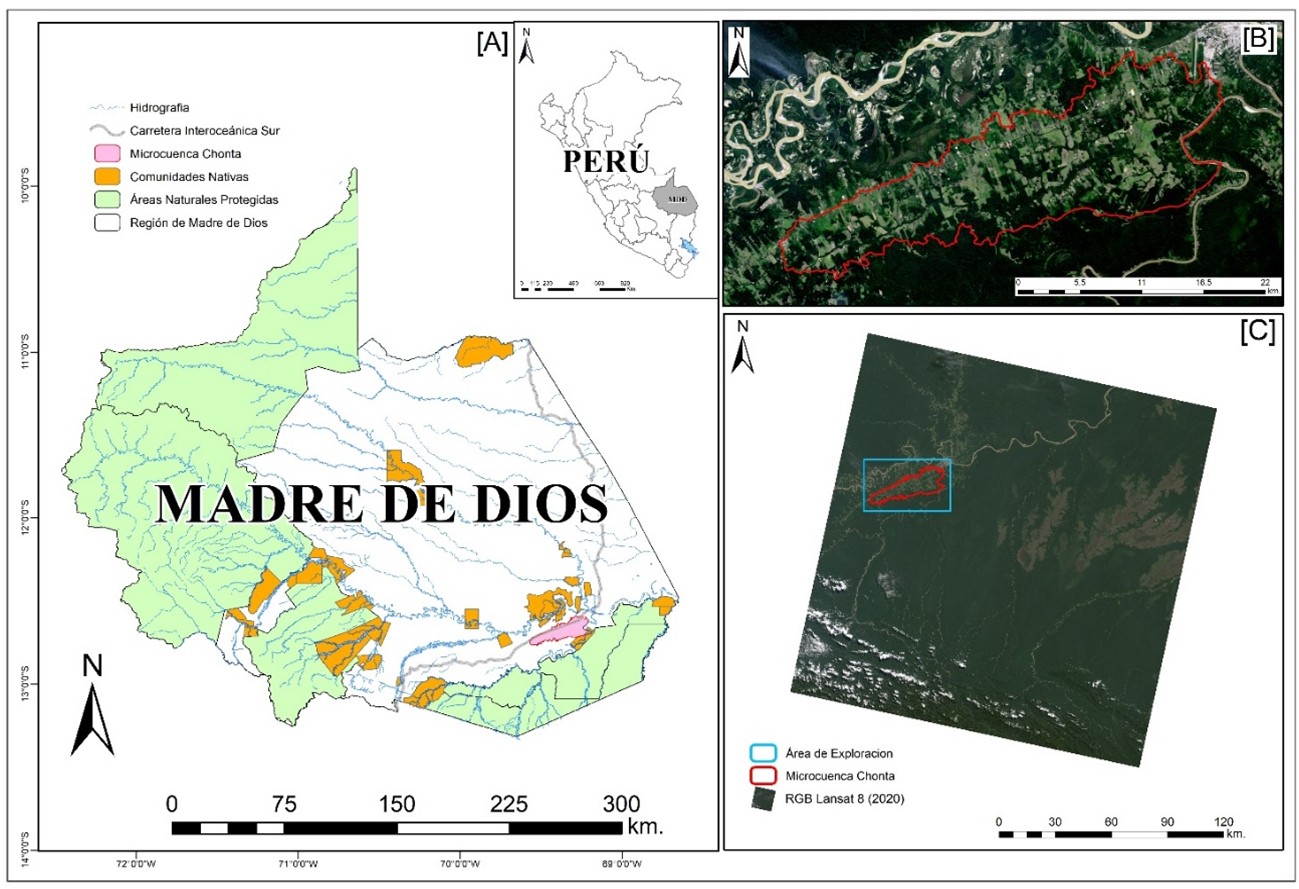
The study quantified forest loss in the Chonta watershed (southern Peruvian Amazon) from 1984 to 2019 using supervised classification of Landsat 5 TM and Landsat 8 OLI satellite imagery to distinguish forest from non-forest areas. Results show a cumulative loss of 43% of the original forest cover, corresponding to an average annual rate of 1.23%, with a strong acceleration after 2000. This trend has intensified landscape fragmentation, reduced ecological connectivity, and increased the vulnerability of biodiversity and ecosystem services. The main drivers identified were shifting agriculture, extensive cattle ranching, illegal logging, and alluvial gold mining, all amplified by improved accessibility linked to the Interoceanic Highway. Without urgent interventions, the watershed may exceed critical thresholds of irreversible degradation; therefore, the study recommends environmental education and technical training for local producers to promote agroforestry systems, agroecology, and land-use planning to safeguard this Amazonian hotspot.
References
Alarcón-Aguirre, G., Canahuire Robles, R. R., Guevara Duarez, F. M., Rodríguez Achata, L., Gallegos Chacón, L. E., & Garate-Quispe, J. (2021). Dinámica de la pérdida de bosques en el sureste de la Amazonia peruana: un estudio de caso en Madre de Dios. Ecosistemas, 30(2), 2175–2175. https://doi.org/10.7818/ECOS.2175
Alarcon Aguirre, G., Zevallos Pollito, P. A., Quispe Herrera, R., Ramos Enciso, D., & Garate-Quispe, J. S. (2020). Conservation value of a forest in the southeast of the Peruvian Amazon: The case of Madre de Dios. Ecosistemas, 29(3). https://doi.org/10.7818/ECOS.1947
Alarcón, G., Díaz, J., Vela, M., García, M., & Gutiérrez, J. (2016). Deforestación en el sureste de la amazonia del Perú entre los años 1999 - 2013; caso Regional de Madre de Dios (Puerto Maldonado – Inambari). Revista de Investigaciones Altoandinas - Journal of High Andean Research, 18(3), 319–330. https://doi.org/10.18271/ria.2016.221
Armenteras, D., & Rodríguez, N. (2014). Dinámicas y causas de deforestación en bosques de latino américa: una revisión desde 1990. Colombia Forestal, 17(2), 233. https://doi.org/10.14483/udistrital.jour.colomb.for.2014.2.a07
Baez, S., Dueñas, H., Mamani, J., & Garate, J. (2017). Flora y vegetación de la Microcuenca Chonta , distrito Tambopata y Laberinto , Departamento de Madre de Dios – Perú . 1, 1–5.
Borràs, J., Delegido, J., Pezzola, A., Pereira, M., Morassi, G., & Camps-Valls, G. (2017). Clasificación de usos del suelo a partir de imágenes Sentinel-2. Revista de Teledetección, 48, 55. https://doi.org/10.4995/raet.2017.7133
Caballero Espejo, J., Messinger, M., Román-Dañobeytia, F., Ascorra, C., Fernandez, L., & Silman, M. (2018). Deforestation and Forest Degradation Due to Gold Mining in the Peruvian Amazon: A 34-Year Perspective. Remote Sensing, 10(12), 1903. https://doi.org/10.3390/rs10121903
Chacón, M., Harvey, C. A., & Delgado, D. (2007). Diversidad arbórea y almacenamiento de carbono en un paisaje fragmentado del bosque húmedo de la zona atlántica de Costa Rica. Recursos Naturales y Ambiente, 51–52(51), 19–32.
Chuvieco, S. E. (2023). Teledetección ambiental: la observación de la Tierra desde el Espacio. Digital Reasons SC.
Csillik, O., & Asner, G. P. (2020). Aboveground carbon emissions from gold mining in the Peruvian Amazon. Environmental Research Letters, 15(1), 014006. https://doi.org/10.1088/1748-9326/ab639c
Dourojeanni, M. (2022). ¿Es posible detener la deforestación en la Amazonía peruana? In A. Castro & M. I. Merino Gómez (Eds.), Desafíos y perspectivas de la situación ambiental en el Perú: en el marco de la conmemoración de los 200 años de vida republicana (pp. 248–284). Pontificia Universidad Católica del Perú. https://doi.org/10.18800/978-9972-674-30-3
FAO. (2020). Evalaucion de los recursos forestales mundiales: Términos y Definiciones FRA 2020 (Issue 188).
Foody, G. M. (2020). Explaining the unsuitability of the kappa coefficient in the assessment and comparison of the accuracy of thematic maps obtained by image classification. Remote Sensing of Environment, 239, 111630. https://doi.org/10.1016/j.rse.2019.111630
Gao, Y., Zhao, T., & Zhao, Y. (2020). Analysis and Research on the Change of Landscape Ecological Pattern in the Surrounding Area of Guishan in Yuyao City. IOP Conference Series: Earth and Environmental Science, 513, 012018. https://doi.org/10.1088/1755-1315/513/1/012018
Gatti, L. V., Basso, L. S., Miller, J. B., Gloor, M., Gatti Domingues, L., Cassol, H. L. G., Tejada, G., Aragão, L. E. O. C., Nobre, C., Peters, W., Marani, L., Arai, E., Sanches, A. H., Corrêa, S. M., Anderson, L., Von Randow, C., Correia, C. S. C., Crispim, S. P., & Neves, R. A. L. (2021). Amazonia as a carbon source linked to deforestation and climate change. Nature, 595(7867), 388–393. https://doi.org/10.1038/S41586-021-03629-6;SUBJMETA
Ghanbari, S., Sefidi, K., Kern, C. C., & Álvarez-Álvarez, P. (2021). Population Structure and Regeneration Status of Woody Plants in Relation to the Human Interventions, Arasbaran Biosphere Reserve, Iran. Forests, 12(2), 191. https://doi.org/10.3390/f12020191
Haddad, N. M., Brudvig, L. A., Clobert, J., Davies, K. F., Gonzalez, A., Holt, R. D., Lovejoy, T. E., Sexton, J. O., Austin, M. P., Collins, C. D., Cook, W. M., Damschen, E. I., Ewers, R. M., Foster, B. L., Jenkins, C. N., King, A. J., Laurance, W. F., Levey, D. J., Margules, C. R., … Townshend, J. R. (2015). Habitat fragmentation and its lasting impact on Earth’s ecosystems. Science Advances, 1(2). https://doi.org/10.1126/sciadv.1500052
Hilty, J., Worboys, G. L., Keeley, A., Woodley, S., Lausche, B. J., Locke, H., Carr, M., Pulsford, I., Pittock, J., White, J. W., Theobald, D. M., Levine, J., Reuling, M., Watson, J. E. M., Ament, R., & Tabor, G. M. (2020). Guidelines for conserving connectivity through ecological networks and corridors. Guidelines for Conserving Connectivity through Ecological Networks and Corridors. https://doi.org/10.2305/IUCN.CH.2020.PAG.30.EN
Jakovac, C. C., Junqueira, A. B., Crouzeilles, R., Peña‐Claros, M., Mesquita, R. C. G., & Bongers, F. (2021). The role of land‐use history in driving successional pathways and its implications for the restoration of tropical forests. Biological Reviews, 96(4), 1114–1134. https://doi.org/10.1111/brv.12694
Landis, J. R., & Koch, G. G. (1977). The Measurement of Observer Agreement for Categorical Data. Biometrics, 33(1), 159–174.
Lapola, D. M., Pinho, P., Barlow, J., Aragão, L. E. O. C., Berenguer, E., Carmenta, R., Liddy, H. M., Seixas, H., Silva, C. V. J., Silva, C. H. L., Alencar, A. A. C., Anderson, L. O., Armenteras, D., Brovkin, V., Calders, K., Chambers, J., Chini, L., Costa, M. H., Faria, B. L., … Walker, W. S. (2023). The drivers and impacts of Amazon forest degradation. Science, 379(6630). https://doi.org/10.1126/SCIENCE.ABP8622
Lovejoy, T. E., & Nobre, C. (2018). Amazon tipping point. Science Advances , 4(2). https://doi.org/10.1126/SCIADV.AAT2340;JOURNAL:JOURNAL:SCIADV;WEBSITE:WEBSITE:AAAS-SITE;REQUESTEDJOURNAL:JOURNAL:SCIADV;WGROUP:STRING:PUBLICATION
MAAP. (2023). MAAP #185: Deforestación por Minería de Oro en la Amazonía Peruana Sur: Actualización 2021-2022.
Nunes, C. A., Berenguer, E., França, F., Ferreira, J., Lees, A. C., Louzada, J., Sayer, E. J., Solar, R., Smith, C. C., Aragão, L. E. O. C., Braga, D. de L., de Camargo, P. B., Cerri, C. E. P., de Oliveira, R. C., Durigan, M., Moura, N., Oliveira, V. H. F., Ribas, C., Vaz-de-Mello, F., … Barlow, J. (2022). Linking land-use and land-cover transitions to their ecological impact in the Amazon. Proceedings of the National Academy of Sciences, 119(27). https://doi.org/10.1073/pnas.2202310119
Olofsson, P., Foody, G. M., Herold, M., Stehman, S. V., Woodcock, C. E., & Wulder, M. A. (2014). Good practices for estimating area and assessing accuracy of land change. Remote Sensing of Environment, 148, 42–57. https://doi.org/10.1016/j.rse.2014.02.015
Pellicer, S., Alcón, M., Morán, T., & Fernández-Landa, J. A. (2017). ForestCO2: Monitorización de sumideros de carbono en masas de Pinus halepensis en la Región de Murcia. November, 27–30.
Potapov, P., Hansen, M. C., Pickens, A., Hernandez-Serna, A., Tyukavina, A., Turubanova, S., Zalles, V., Li, X., Khan, A., Stolle, F., Harris, N., Song, X.-P., Baggett, A., Kommareddy, I., & Kommareddy, A. (2022). The Global 2000-2020 Land Cover and Land Use Change Dataset Derived From the Landsat Archive: First Results. Frontiers in Remote Sensing, 3, 856903. https://doi.org/10.3389/frsen.2022.856903
Puerta, R., & Iannacone, J. (2023). Analysis of forest cover in Parque Nacional Tingo María (Peru) using the random forest algorithm. Scientia Agropecuaria, 14(3), 291–300. https://doi.org/10.17268/sci.agropecu.2023.025
Pyngrope, O. R., Kumar, M., Pebam, R., Singh, S. K., Kundu, A., & Lal, D. (2021). Investigating forest fragmentation through earth observation datasets and metric analysis in the tropical rainforest area. SN Applied Sciences, 3(7), 705. https://doi.org/10.1007/s42452-021-04683-5
Rosales, R. (2008). Potencial forestal y deforestación en márgenes de la carretera El Castañal-Santa Rosa de Tambopata. Universidad de Piura.
Salas, R., Barboza, E., & Oliva, M. (2016). Dinámica multitemporal de índices de deforestación en el distrito de Florida, departamento de Amazonas, Perú. June. https://doi.org/10.25127/indes.201401.00
Swenson, J. J., Carter, C. E., Domec, J.-C., & Delgado, C. I. (2011). Gold Mining in the Peruvian Amazon: Global Prices, Deforestation, and Mercury Imports. PLoS ONE, 6(4), e18875. https://doi.org/10.1371/journal.pone.0018875
Vinet, L., & Zhedanov, A. (2011). A ‘missing’ family of classical orthogonal polynomials. Journal of Physics A: Mathematical and Theoretical, 44(8), 085201. https://doi.org/10.1088/1751-8113/44/8/085201
Downloads
Published
How to Cite
Issue
Section
License
Copyright (c) 2023 Rembrandt Canahuire-Robles

This work is licensed under a Creative Commons Attribution 4.0 International License.