Importance Value Index and Tree Diversity in the Washington Mining Concession, Inambari, Madre de Dios, Peru
DOI:
https://doi.org/10.55873/xm9b0168Keywords:
Importance Value Index, Tree diversity, Amazon rainforest, Mining concession, Ecological restorationAbstract
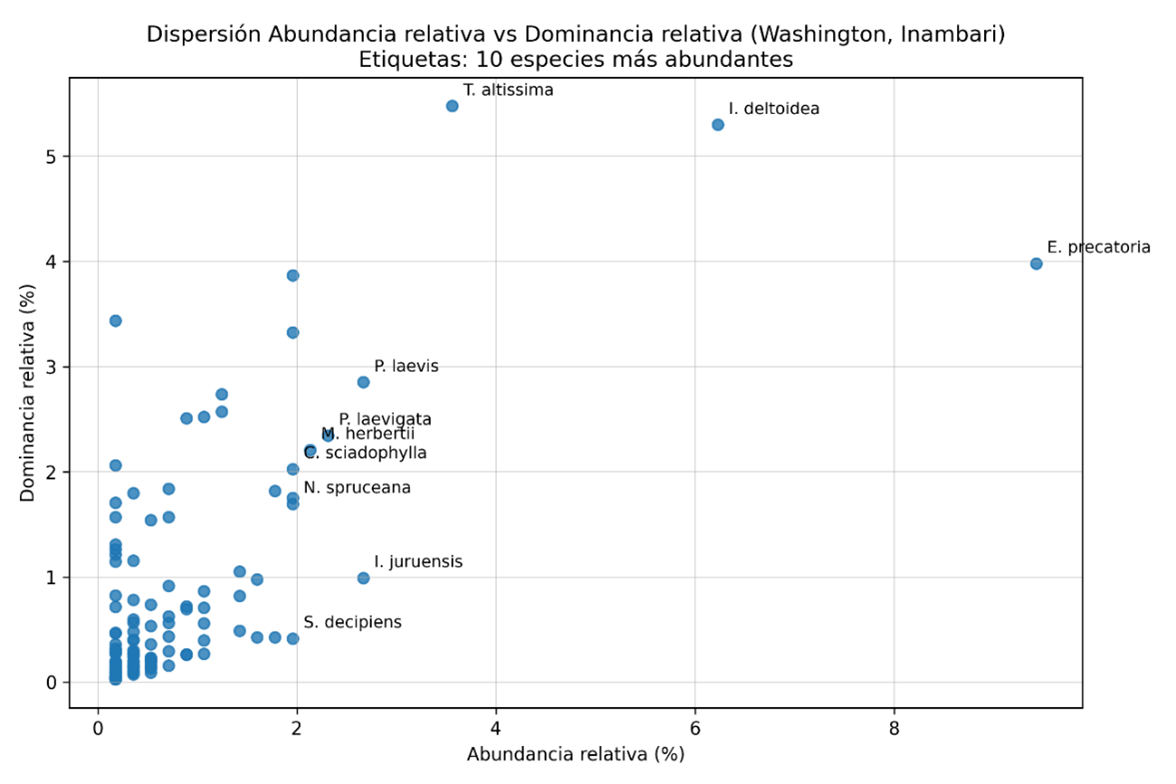
Gold mining in Madre de Dios has fragmented forests and degraded soils, creating uncertainty about which species maintain stand structure in mining concessions. This study aimed to estimate the Importance Value Index (IVI) and characterize tree diversity in the Washington mining concession in the Inambari River basin. A 100 × 10 m plot was established, and all individuals with DBH ≥ 10 cm were inventoried, recording species identity, diameter, and total height. Species-level IVI was calculated from relative abundance, frequency, and dominance; diversity indices were also estimated, and species were classified by commercial value (B–E). In total, 562 individuals representing 154 species were recorded. The highest structural importance was found for Euterpe precatoria, Iriartea deltoidea, and Tetragastris altissima, indicating that dominance arises from combined effects of abundance and basal area. Diversity metrics showed high heterogeneity and moderate dominance. From an economic perspective, category E (low value) predominated, whereas high- and medium-value categories accounted for smaller shares. Overall, the assessed forest retains high diversity, but its structure is driven by a few key species; IVI is a useful tool for prioritizing species in forest management and restoration in mining-impacted landscapes.
References
(SERFOR), S. N. F. y de F. S. (2016). Metodología para la determinación del valor al estado natural de la madera para el pago de derecho del aprovechamiento y los Valores al estado natural de la madera. Resolución de Dirección Ejecutiva N° 241-2016-SERFOR-DE. Servicio Nacional Forestal y de Fauna Silvestre. https://faolex.fao.org/docs/pdf/per160867.pdf
Alarcón-Aguirre, G., Sajami Quispe, E., Vásquez Zavaleta, T., Ponce Tejada, L. V., Ramos Enciso, D., Rodríguez Achata, L., & Garate-Quispe, J. (2023). Vegetation dynamics in lands degraded by gold mining in the southeastern Peruvian Amazon. Trees, Forests and People, 11, 100369. https://doi.org/10.1016/j.tfp.2023.100369
Alvarez-Montalván, C. E., Manrique-León, S., Vela-Da Fonseca, M., Cardozo-Soarez, J., Callo-Ccorcca, J., Bravo-Camara, P., Castañeda-Tinco, I., & Alvarez-Orellana, J. (2021). Floristic composition, structure and tree diversity of an amazon forest in Peru. Scientia Agropecuaria, 12(1), 73–82. https://doi.org/10.17268/sci.agropecu.2021.009
Brako, L., & Zarucchi, J. L. (1993). Catalogue of the Flowering Plants and Gymnosperms of Peru = Catálogo de las angiospermas y gimnospermas del Perú (Vol. 45). Missouri Botanical Garden.
Caballero Espejo, J., Messinger, M., Román-Dañobeytia, F., Ascorra, C., Fernandez, L. E., & Silman, M. (2018). Deforestation and Forest Degradation Due to Gold Mining in the Peruvian Amazon: A 34-Year Perspective. Remote Sensing, 10(12), 1903. https://doi.org/10.3390/rs10121903
Chambi-Legoas, R., Ortega Rodriguez, D. R., de Marques de Figueiredo, F., Peña Valdeiglesias, J., Zevallos Pollito, P. A., Marcelo-Peña, J. L., & Rother, D. C. (2021). Natural Regeneration After Gold Mining in the Peruvian Amazon: Implications for Restoration of Tropical Forests. Frontiers in Forests and Global Change, 4, 594627. https://doi.org/10.3389/ffgc.2021.594627
Chao, A., Gotelli, N. J., Hsieh, T. C., Sander, E. L., Ma, K. H., Colwell, R. K., & Ellison, A. M. (2014). Rarefaction and extrapolation with Hill numbers: a framework for sampling and estimation in species diversity studies. Ecological Monographs, 84(1), 45–67. https://doi.org/10.1890/13-0133.1
Cueva, K. (2015). Metodología de procesamiento y análisis de datos del Inventario Forestal Nacional (IFN). Programa Nacional Conjunto ONU-REDD Paraguay / Instituto Forestal Nacional.
Diringer, S. E., Berky, A. J., Marani, M., Ortiz, E. J., Karatum, O., Plata, D. L., Pan, W. K., & Hsu-Kim, H. (2020). Deforestation Due to Artisanal and Small-Scale Gold Mining Exacerbates Soil and Mercury Mobilization in Madre de Dios, Peru. Environmental Science & Technology, 54(1), 286–296. https://doi.org/10.1021/acs.est.9b06620
Garate-Quispe, J., Canahuire-Robles, R., Alarcón-Aguirre, G., Dueñas-Linares, H., & Roman-Dañobeytia, F. (2024). Changes in floristic and vegetation structure in a chronosequence of abandoned gold-mining lands in a tropical Amazon forest. Heliyon, 10(9), e29908. https://doi.org/10.1016/j.heliyon.2024.e29908
Garate-Quispe, J. S., Canahuire-Robles, R., Surco-Huacachi, O., & Alarcón-Aguirre, G. (2021). Desarrollo estructural y composición florística arbórea en áreas afectadas por minería aurífera en la Amazonía peruana: a 20 años de su reforestación. Revista Mexicana de Biodiversidad, 92, e923437. https://doi.org/10.22201/ib.20078706e.2021.92.3437
García Huamán, N. S. (2023). Diversidad, composición arbórea y valoración económica de un bosque intervenido por la actividad minera metálica en el sector de Boca Inambari, Tambopata - Madre de Dios [Universidad Nacional Amazónica de Madre de Dios]. http://hdl.handle.net/20.500.14070/958
Gotelli, N. J., & Colwell, R. K. (2001). Quantifying biodiversity: procedures and pitfalls in the measurement and comparison of species richness. Ecology Letters, 4(4), 379–391. https://doi.org/10.1046/j.1461-0248.2001.00230.x
Herrera-Machaca, M., Ancco-Mamani, C., Alarcon Aguirre, G., Gonzales-Alvarado, A. C., & Garate-Quispe, J. (2024). Soil amendments influence early plant survival and growth in reclamation of severely degraded lands by gold mining in the Peruvian Amazon. Journal of Degraded and Mining Lands Management, 11(4), 6277–6284. https://doi.org/10.15243/jdmlm.2024.114.6277
Lamprecht, H. (1990). Silvicultura en los trópicos: los ecosistemas forestales en los bosques tropicales y sus especies arbóreas; posibilidades y métodos para un aprovechamiento sostenido. Deutsche Gesellschaft für Technische Zusammenarbeit (GTZ).
Pastrana Sandoval, D. K. (2014). Composición florística y valoración económica de las especies maderables comerciales en un bosque natural de colina baja distrito del Napo río Tacshacuraray, Loreto-Perú [Universidad Nacional de la Amazonía Peruana]. http://repositorio.unapiquitos.edu.pe/handle/20.500.12737/3573
Quispe Ore, S. (2019). Estructura horizontal de especies forestales comerciales en la Concesión Forestal Shayjame S.A.C. - Tahuamanu - Madre de Dios [Universidad Nacional del Centro del Perú]. http://hdl.handle.net/20.500.12894/5486
Ramírez Guaman, T. G., & Lozano, D. (2024). Diversidad florística y estructura de la regeneración natural del bosque piemontano con intervención de manejo forestal en el sur de Ecuador. Bosques Latitud Cero, 14(1), 105–122. https://doi.org/10.54753/blc.v14i1.2034
Recavarren Estares, P., Delgado Obando, M., Angulo Lovatón, M. A., León Taquia, A. A., & Castro Revilla, A. (2011). Proyecto REDD en Áreas Naturales Protegidas de Madre de Dios: insumos para la elaboración de la línea base de carbono. Asociación para la Investigación y el Desarrollo Integral (AIDER). https://aider.com.pe/publicaciones/REDD-en-Areas-Naturales-Protegidas-Madre-de-Dios.pdf
Rosales-Solórzano, E. R. (n.d.). Categorización de especies forestales en grupos comerciales por tipos de bosque del eje carretero Interoceánico Sur en Tambopata, Madre de Dios. Biodiversidad Amazónica.
Silva-González, E., Aguirre-Calderón, O. A., Alanís-Rodríguez, E., González-Tagle, M. A., Treviño-Garza, E. J., & Corral-Rivas, J. J. (2022). Evaluación del aprovechamiento forestal en la diversidad y estructura de un bosque templado en Durango. Revista Mexicana de Ciencias Forestales, 13(71). https://doi.org/10.29298/rmcf.v13i71.1017
Downloads
Published
Issue
Section
License
Copyright (c) 2026 Rosario Bernaola-Paucar, Luis Nieto-Ramos, Carlos Nieto-Ramos

This work is licensed under a Creative Commons Attribution 4.0 International License.