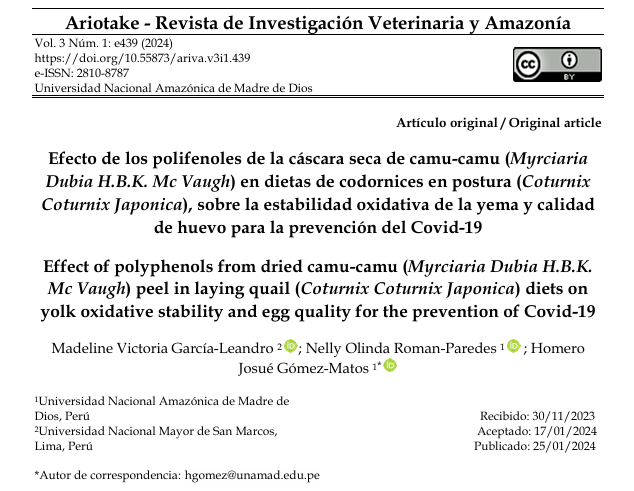
Effect of Polyphenols from the Dry Shell of camu-camu (Myrciaria Dubia H.B.K. Mc Vaugh) in diets of Laying Quail (Coturnix Coturnix Japonica), on the Oxidative Stability of the Yolk and Egg Quality for the Prevention of Covid-19
DOI:
https://doi.org/10.55873/rd4vax41Keywords:
camu-camu, egg quality, laying quails, oxidative stability, productive performanceAbstract
The objective was to evaluate the effect of dried camu-camu peel (Myrciaria dubia) inclusion in the diets of laying quails (Coturnix japonica) on productive performance, egg quality, and yolk oxidative stability, within the context of interest in functional foods during the COVID-19 pandemic. A total of 144 quails were assigned to two treatments for six weeks: a control diet and a diet containing 1% camu-camu peel. No significant differences (p > 0.05) were observed in yolk color, laying rate, egg mass, feed intake, or feed conversion ratio. The supplemented treatment showed favorable numerical trends in egg mass (292.15 g), laying rate (82.74%), and feed conversion ratio (3.21 kg/kg). MDA concentrations were 0.735 and 0.982 μg/g of yolk in the control and experimental treatments, respectively.
References
Abeyrathne, E. D. N. S., Lee, H. Y., & Ahn, D. U. (2013). Egg white proteins and their potential use in food processing or as nutraceutical and pharmaceutical agents—A review. Poultry Science, 92(12), 3292–3299. https://doi.org/10.3382/ps.2013-03391
Anton, M., Nau, F., & Nys, Y. (2006). Bioactive egg components and their potential uses. World’s Poultry Science Journal, 62(03), 429. https://doi.org/10.1017/S004393390600105X
Araújo, P. A. da C., García, V. A. dos S., Osiro, D., Franca, D. de S., Vanin, F. M., & Carvalho, R. A. de. (2022). Active compounds from the industrial residue of dry camu-camu. Food Science and Technology, 42. https://doi.org/10.1590/fst.05321
Barreto, S. L. de T., Quirino, B. J. de S., Brito, C. O., Umigi, R. T., Araujo, M. S. de, Rocha, T. C. da, & Pereira, C. G. (2007). Efeitos de níveis nutricionais de energia sobre o desempenho e a qualidade de ovos de codornas européias na fase inicial de postura. Revista Brasileira de Zootecnia, 36(1), 86–93. https://doi.org/10.1590/S1516-35982007000100011
Botsoglou, N. A., Fletouris, D. J., Papageorgiou, G. E., Vassilopoulos, V. N., Mantis, A. J., & Trakatellis, A. G. (1994). Rapid, Sensitive, and Specific Thiobarbituric Acid Method for Measuring Lipid Peroxidation in Animal Tissue, Food, and Feedstuff Samples. Journal of Agricultural and Food Chemistry, 42(9), 1931–1937. https://doi.org/10.1021/jf00045a019
Chirinos, R., Galarza, J., Betalleluz-Pallardel, I., Pedreschi, R., & Campos, D. (2010). Antioxidant compounds and antioxidant capacity of Peruvian camu camu (Myrciaria dubia (H.B.K.) McVaugh) fruit at different maturity stages. Food Chemistry, 120(4), 1019–1024. https://doi.org/10.1016/j.foodchem.2009.11.041
das Chagas, E. G. L., Vanin, F. M., dos Santos Garcia, V. A., Yoshida, C. M. P., & de Carvalho, R. A. (2021). Enrichment of antioxidants compounds in cookies produced with camu-camu (Myrciaria dubia) coproducts powders. LWT, 137, 110472. https://doi.org/10.1016/j.lwt.2020.110472
Fidelis, M., do Carmo, M. A. V., da Cruz, T. M., Azevedo, L., Myoda, T., Miranda Furtado, M., Boscacci Marques, M., Sant’Ana, A. S., Inês Genovese, M., Young Oh, W., Wen, M., Shahidi, F., Zhang, L., Franchin, M., de Alencar, S. M., Luiz Rosalen, P., & Granato, D. (2020). Camu-camu seed (Myrciaria dubia) – From side stream to an antioxidant, antihyperglycemic, antiproliferative, antimicrobial, antihemolytic, anti-inflammatory, and antihypertensive ingredient. Food Chemistry, 310, 125909. https://doi.org/10.1016/j.foodchem.2019.125909
Kaneshima, T., Myoda, T., Nakata, M., Fujimori, T., Toeda, K., & Nishizawa, M. (2016). Antioxidant activity of C-Glycosidic ellagitannins from the seeds and peel of camu-camu (Myrciaria dubia). LWT - Food Science and Technology, 69, 76–81. https://doi.org/10.1016/j.lwt.2016.01.024
Latimer GW (Ed.). (2019). Official Methods of Analysis of AOAC International (21st ed). Rockville, MD: AOAC International.
Marinho, A. L. (2011). Qualidade interna e externa de ovos de codornas japonesas armazenados em diferentes temperaturas e períodos de estocagem [Universidade Federal de Alagoas]. http://repositorio.ufal.br/handle/riufal/1136
Melgarejo Cabello, S. V. (2018). Uso de residuos sólidos de la industrialización del camu camu (Myrciaria dubia H.B.K. Mc Vaugh) para la extracción de compuestos fenólicos [Universidad Nacional Agraria La Molina]. http://repositorioslatinoamericanos.uchile.cl/handle/2250/1370565
National Research Council. (1994). Nutrient Requirements of Poultry. National Academies Press. https://doi.org/10.17226/2114
Nemati, Z., Moradi, Z., Alirezalu, K., Besharati, M., & Raposo, A. (2021). Impact of Ginger Root Powder Dietary Supplement on Productive Performance, Egg Quality, Antioxidant Status and Blood Parameters in Laying Japanese Quails. International Journal of Environmental Research and Public Health, 18(6), 2995. https://doi.org/10.3390/ijerph18062995
Núñez-Torres, O. P., Delgado-Álvarez, V. E., Almeida-Secará, R. I., & Cruz Quintana, S. M. (2021). Suplementación de jengibre en codornices como alternativa nutricional en la producción y calidad de huevo. Journal of the Selva Andina Animal Science, 8(2), 90. https://doi.org/10.36610/j.jsaas.2021.080200090
Paraiso, I. L., Revel, J. S., & Stevens, J. F. (2020). Potential use of polyphenols in the battle against COVID-19. Current Opinion in Food Science, 32, 149–155. https://doi.org/10.1016/j.cofs.2020.08.004
Prado Antayhua, F. A. (2016). Evaluacion del palillo (Curcuma longa) sobre la respuesta productiva, estabilidad oxidativa de yema y calidad de huevo de codornices japonesas [Universidad Nacional Agraria La Molina]. https://hdl.handle.net/20.500.12996/2603
Saraswati, T. R., Manalu, W., Ekastuti, D. R., & Kusumorini, N. (2013). Increased Egg Production of Japanese Quail (Cortunix japonica) by Improving Liver Function Through Turmeric Powder Supplementation. International Journal of Poultry Science, 12(10), 601–614. https://doi.org/10.3923/ijps.2013.601.614
Villanueva-Tiburcio, J. E., Condezo-Hoyos, L. A., & Asquieri, E. R. (2010). Antocianinas, ácido ascórbico, polifenoles totales y actividad antioxidante, en la cáscara de camu-camu (Myrciaria dubia (H.B.K) McVaugh). Ciência e Tecnologia de Alimentos, 30, 151–160. https://doi.org/10.1590/S0101-20612010000500023
Vuilleumier, J. P. (1969). The ‘Roche Yolk Colour Fan‘—An Instrument for Measuring Yolk Colour. Poultry Science, 48(3), 767–779. https://doi.org/10.3382/ps.0480767
Downloads
Published
Issue
Section
License
Copyright (c) 2026 Madeline Victoria García-Leandro, Nelly Olinda Roman-Paredes, Homero Josué Gómez-Matos

This work is licensed under a Creative Commons Attribution 4.0 International License.