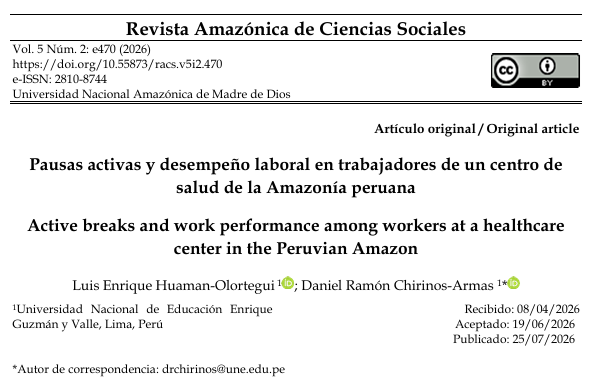
Pausas activas y desempeño laboral en trabajadores de un centro de salud de la Amazonía peruana
DOI:
https://doi.org/10.55873/4syr9808Palabras clave:
desempeño laboral, ejercicio físico, pausas activas, salud ocupacional, trabajadores de saludResumen
El objetivo fue determinar la relación entre la realización de pausas activas y el desempeño laboral en el Centro de Salud San José de Sisa, El Dorado, durante 2020. Se desarrolló un estudio cuantitativo, aplicado, no experimental, transversal y correlacional con una muestra censal de 30 trabajadores. Se aplicaron un cuestionario de pausas activas de 12 ítems y otro de desempeño laboral de 18 ítems, cuyos coeficientes alfa de Cronbach fueron 0,978 y 0,981, respectivamente. El 50 % presentó un nivel bajo de pausas activas y el 47 % un nivel bajo de desempeño. Debido a la distribución observada, las asociaciones se examinaron mediante rho de Spearman. Las pausas activas se relacionaron positiva y significativamente con el desempeño laboral, ρ = 0,859 y p < 0,001. También se identificaron relaciones con los descansos breves, ρ = 0,845, y el ejercicio físico, ρ = 0,842, ambas con p < 0,001. Se concluye que las variables covariaron fuertemente en la muestra, sin que el diseño permita establecer causalidad.
Referencias
Akksilp, K., Koh, J. J. E., Tan, V., Tong, E. H., Budtarad, N., Guo, X., Dieterich, A. V., Tai, B. C., Muller, A. M., Isaranuwatchai, W., Rouyard, T., Nakamura, R., Muller-Riemenschneider, F., Teerawattananon, Y., & Chen, C. (2023). The physical activity at work (PAW) study: a cluster randomised trial of a multicomponent short-break intervention to reduce sitting time and increase physical activity among office workers in Thailand. LANCET REGIONAL HEALTH - SOUTHEAST ASIA, 8, 100086. https://doi.org/10.1016/j.lansea.2022.100086
Albulescu, P., Macsinga, I., Rusu, A., Sulea, C., Bodnaru, A., & Tulbure, B. T. (2022). Give me a break! A systematic review and meta-analysis on the efficacy of micro-breaks for increasing well-being and performance. PLOS ONE, 17(8), e0272460. https://doi.org/10.1371/journal.pone.0272460
Batista-Ferreira, L., Sandy, D. D., Silva, P. C. M. C., Medeiros-Lima, D. J. M., & Rodrigues, B. M. (2024). Impact of active breaks on sedentary behavior and perception of productivity in office workers. Revista Brasileira De Medicina Do Trabalho, 22(2). https://doi.org/10.47626/1679-4435-2023-1213
Davidescu, A. A., Apostu, S.-A., Paul, A., & Casuneanu, I. (2020). Work Flexibility, Job Satisfaction, and Job Performance among Romanian Employees—Implications for Sustainable Human Resource Management. Sustainability, 12(15), 6086. https://doi.org/10.3390/su12156086
Elzomor, A., Tunkel, A., Lee, E., Jaamour, F., Davidson, L., Shaver, T. B., Niermeyer, W., Benito, D., Cole, K., & Zapanta, P. (2022). Intraoperative stretching microbreaks reduce surgery-related musculoskeletal pain in otolaryngologists. AMERICAN JOURNAL OF OTOLARYNGOLOGY, 43(6), 103594. https://doi.org/10.1016/j.amjoto.2022.103594
Falconí Laos, M. A. (2017). Efectividad de la medida pausas activas en el control de lesiones músculo esqueléticas en trabajadores del área de producción de la empresa Tuberías y Geosistemas del Perú, Arequipa, 2016 [Universidad Católica de Santa María]. https://repositorio.ucsm.edu.pe/items/195a1516-bd58-4d30-8b59-c594e764acf7
Fischetti, F., Pepe, I., Greco, G., Ranieri, M., Poli, L., Cataldi, S., & Vimercati, L. (2024). Ten-Minute Physical Activity Breaks Improve Attention and Executive Functions in Healthcare Workers. Journal of Functional Morphology and Kinesiology, 9(2), 102. https://doi.org/10.3390/jfmk9020102
Griffiths, T. D., Crone, D., Stembridge, M., & Lord, R. N. (2022). Co-production at work: The process of breaking up sitting time to improve cardiovascular health. A pilot study. International Journal of Environmental Research and Public Health, 19(1), 361. https://doi.org/10.3390/ijerph19010361
Huamán Alvarez, M. F. (2018). Motivación y desempeño laboral en trabajadores asistenciales del Centro de Salud Belenpampa, Cusco [Universidad César Vallejo]. https://repositorio.ucv.edu.pe/handle/20.500.12692/37559
Jin, M., Swainson, M., Wang, C., & Morris, A. (2025). Systematic review: Occupational sedentary behaviour and common mental health symptoms. Occupational Medicine, 75(6), 275–281. https://doi.org/10.1093/occmed/kqaf072
Kim, S., Cho, S., & Park, Y. (2022). Daily Microbreaks in a Self-Regulatory Resources Lens: Perceived Health Climate as a Contextual Moderator via Microbreak Autonomy. JOURNAL OF APPLIED PSYCHOLOGY, 107(1), 60–77. https://doi.org/10.1037/apl0000891
Kim, S., Park, Y., & Headrick, L. (2018). Daily micro-breaks and job performance: General work engagement as a cross-level moderator. Journal of Applied Psychology, 103(7), 772–786. https://doi.org/10.1037/apl0000308
Labecka, M. K., Plandowska, M., Truszczynska-Baszak, A., Rajabi, R., Rozanska, D., & Plaszewski, M. (2024). Effects of the active break intervention on nonspecific low back pain among young people: a randomized controlled trial. BMC MUSCULOSKELETAL DISORDERS, 25(1), 1055. https://doi.org/10.1186/s12891-024-08186-3
Leppe-Zamora, J., Ramos-Fuster, S., Muñoz-Monari, B., Roa-Alcaino, S., & Sarmiento, O. L. (2025). The effect of computer prompt in breaks of sedentary behaviour among office workers: a systematic review and meta-analysis. International Journal of Behavioral Nutrition and Physical Activity, 22(1). https://doi.org/10.1186/s12966-025-01781-0
Lyubykh, Z., Gulseren, D., Premji, Z., Wingate, T. G., Deng, C., Belanger, L. J., & Turner, N. (2022). Role of Work Breaks in Well-Being and Performance: A Systematic Review and Future Research Agenda. JOURNAL OF OCCUPATIONAL HEALTH PSYCHOLOGY, 27(5), 470–487. https://doi.org/10.1037/ocp0000337
Michaud, T. L., You, W., Estabrooks, P. A., Leonard, K., Rydell, S. A., Mullane, S. L., Pereira, M. A., & Buman, M. P. (2022). Cost and cost-effectiveness of the “Stand and Move at Work” multicomponent intervention to reduce workplace sedentary time and cardiometabolic risk. SCANDINAVIAN JOURNAL OF WORK ENVIRONMENT & HEALTH, 48(5), 399–409. https://doi.org/10.5271/sjweh.4022
Moreira, S., Criado, M. B., Ferreira, M. S., Machado, J., Goncalves, C., Clemente, F. M., Mesquita, C., Lopes, S., & Santos, P. C. (2022). Positive Effects of an Online Workplace Exercise Intervention during the COVID-19 Pandemic on Quality of Life Perception in Computer Workers: A Quasi-Experimental Study Design. INTERNATIONAL JOURNAL OF ENVIRONMENTAL RESEARCH AND PUBLIC HEALTH, 19(5), 3142. https://doi.org/10.3390/ijerph19053142
Morton, S., Fitzsimons, C., Sivaramakrishnan, D., Jepson, R., & Niven, A. (2024). “Are we working (too) comfortably?”: a focus group study to understand sedentary behaviour when working at home and identify intervention strategies. BMC Public Health, 24(1). https://doi.org/10.1186/s12889-024-18892-1
Ojo, S. O., Bailey, D. P., Chater, A. M., & Hewson, D. J. (2022). Workplace Intervention for Reducing Sitting Time in Sedentary Workers: Protocol for a Pilot Study Using the Behavior Change Wheel. FRONTIERS IN PUBLIC HEALTH, 10, 832374. https://doi.org/10.3389/fpubh.2022.832374
Ojo, S. O., Chater, A. M., Hewson, D. J., & Bailey, D. P. (2024). Workplace Productivity, Health and Wellbeing: Findings From a Cluster Randomised Controlled Trial of a Workplace Intervention to Reduce Sitting in Office Workers. Journal of Occupational and Environmental Medicine, 66(6), 487–494. https://doi.org/10.1097/jom.0000000000003091
Rabal-Pelay, J., Cimarras-Otal, C., Coscolla-Palma, S., Burillo-Villuendas, A., Villalba-Ruete, J. A., & Bataller-Cervero, A. V. (2025). Effect of active breaks on stress and musculoskeletal discomfort during work in office workers. Sport Sciences for Health, 21(4), 2835–2843. https://doi.org/10.1007/s11332-025-01488-6
Radwan, A., Barnes, L., DeResh, R., Englund, C., & Gribanoff, S. (2022). Effects of active microbreaks on the physical and mental well-being of office workers: A systematic review. Cogent Engineering, 9(1), 2026206. https://doi.org/10.1080/23311916.2022.2026206
Ribadeneira Campozano, M. S. (2015). Diseño de un programa de pausas activas para disminuir el riesgo ergonómico en el área de descabezado de Industrial Pesquera Santa Priscila S. A. Universidad de Guayaquil.
Smit, D. J. M., Burgers, L. J. G. C., van Oostrom, S. H., Vähä-Ypyä, H., Husu, P., Verswijveren, S. J. J. M., & Proper, K. I. (2024). Exploring Associations Between Device-Based Occupational Sedentary Behavior and Need for Recovery in White Collar Workers: A Compositional Data-Analysis. International Journal of Public Health, 69. https://doi.org/10.3389/ijph.2024.1607322
Sortino, M., Trovato, B., Zanghi, M., Roggio, F., & Musumeci, G. (2024). Active Breaks Reduce Back Overload during Prolonged Sitting: Ergonomic Analysis with Infrared Thermography. JOURNAL OF CLINICAL MEDICINE, 13(11), 3178. https://doi.org/10.3390/jcm13113178
Vitoulas, S., Konstantis, V., Drizi, I., Vrouva, S., Koumantakis, G. A., & Sakellari, V. (2022). The Effect of Physiotherapy Interventions in the Workplace through Active Micro-Break Activities for Employees with Standing and Sedentary Work. HEALTHCARE, 10(10), 2073. https://doi.org/10.3390/healthcare10102073
Voros, P., & Kozinc, Z. (2023). Preliminary investigation of the effects of sitting with and without short active breaks on muscle stiffness assessed with shear-wave elastography. SPORT SCIENCES FOR HEALTH, 19(4), 1209–1216. https://doi.org/10.1007/s11332-023-01051-1
Descargas
Publicado
Número
Sección
Licencia
Derechos de autor 2026 Luis Enrique Huaman-Olortegui, Daniel Ramón Chirinos-Armas

Esta obra está bajo una licencia internacional Creative Commons Atribución 4.0.