Reading Strategies and Academic Performance: A Correlational Analysis Among Secondary School Students
DOI:
https://doi.org/10.55873/vfpbkf49Keywords:
cognitive skills, educational competencies, school motivation, secondary education, self-regulated learningAbstract
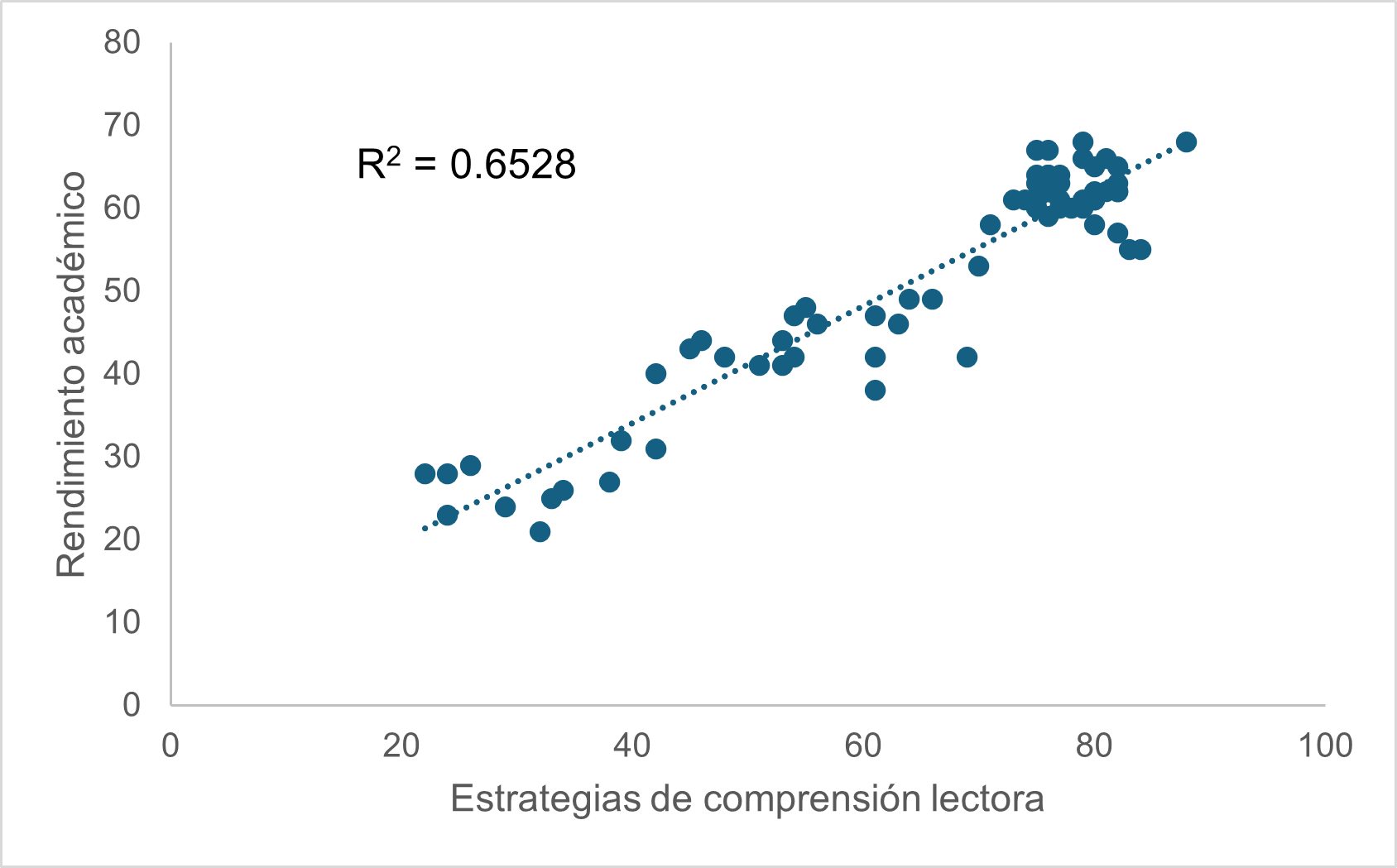
This study aimed to analyze the relationship between cognitive, metacognitive, and socio-affective reading comprehension strategies and academic performance among secondary school students in Tarapoto, Peru. A quantitative, descriptive-correlational study with a non-experimental, cross-sectional design was conducted. Seventy students participated and were assessed using a questionnaire and an observation checklist. Data were analyzed using descriptive statistics, Pearson's chi-square test, and Spearman's correlation. Results showed that 61.4% of students reported high levels of reading strategy use, with metacognitive strategies being the most prevalent (70.0%). A significant association was identified between reading comprehension and academic performance (χ² = 115.378; p < 0.001), alongside a strong positive overall correlation (rho = 0.808; p < 0.001). Socio-affective strategies exhibited the highest correlation (rho = 0.852). The study concluded that reading strategies were significantly associated with academic performance, particularly the socio-affective dimension.
References
Abdelrahman, R. M. (2020). Metacognitive awareness and academic motivation and their impact on academic achievement of Ajman University students. Heliyon, IX(6). doi:https://doi.org/10.1016/j.heliyon.2020.e04192
Agustin, , W., Wahyudin A. , Y., & Isnaini , S. (2021). Language learning strategies and academic achievement of english department students. Journal of Arts and Education, I(1). doi:https://doi.org/10.33365/jae.v1i1.34
Alvarado Guevara , E., Rosales León , T. F., Alarcón Diaz, M. A., Alcas Zapata, N., Luy Montejo, C. A., & Núñez Lira , L. A. (2020). Teaching strategies for text comprehension of basic education students.
Arhuis Inca , W., & Ipanaqué Zapata, , M. (2023). La relación entre las habilidades sociales, bienestar psicológico y rendimiento académico en estudiantado universitario de Chimbote, Perú. Revista Electrónica Educare, 2(27), 1–14. doi:https://doi.org/10.15359/ree.27-2.15848
Capin, P., Stevens, E. A., & Vaughn, S. (2023). Self‐Regulation and Reading Comprehension: Integrating and Aligning to Improve Reading Outcomes. Mind, Brain, and Education, IV(17), 362–372. doi:https://doi.org/10.1111/mbe.12353
Carmona-Halty, M., Salanova, M., Llorens, S., & Schaufeli, W. B. (2021). Linking positive emotions and academic performance: The mediated role of academic psychological capital and academic engagement. Current Psychology, VI(40), 2938–2947. doi:https://doi.org/10.1007/s12144-019-00227-8
Duke N. , K., Ward A. , E., & Pearson P. , D. (2021). The Science of Reading Comprehension Instruction. The Reading Teacher, 6(74), 663–672. doi:https://doi.org/10.1002/trtr.1993
Filderman, M. J., Austin, C. R., Boucher, A. N., O’Donnell, K., & Swanson, E. A. (2022). A Meta-Analysis of the Effects of Reading Comprehension Interventions on the Reading Comprehension Outcomes of Struggling Readers in Third Through 12th Grades. Exceptional Children, II(88), 163–184. doi:https://doi.org/10.1177/00144029211050860
Garay Argandoña, R., Campos Ugaz, O., Palacios Garay, J. P., Ocaña Fernandez, Y., M. Hernández, R., Alanya Beltran, J., . . . Apiratwarakul, K. (2022). “Home to Hall”: Utilization of Modular Learning Approach and Its Relationship to the Reading Attitude and Performance of Basic Education Learners in the New Normal Context of Peru. Journal of Positive Psychology and Wellbeing, I(6), 307–315. Obtenido de http://184.168.115.16/index.php/jppw/article/view/681
Kim, Y.-S. G. (2020). Hierarchical and dynamic relations of language and cognitive skills to reading comprehension: Testing the direct and indirect effects model of reading (DIER). Journal of Educational Psychology, 112(4), 667–684. doi:https://doi.org/10.1037/edu0000407
MacCann, C., Jiang, Y., Brown, L. E., Double, K. S., Bucich, M., & Minbashian, A. (2020). Emotional intelligence predicts academic performance: A meta-analysis. Psychological Bulletin, II(146), 150. Obtenido de https://psycnet.apa.org/fulltext/2019-74947-001.html
Mohammadi, R. R., Saeidi, M., & Ahangari, S. (2020). Self-regulated learning instruction and the relationships among self-regulation, reading comprehension and reading problem solving: PLS-SEM approach. Cogent Education, I(7). doi:https://doi.org/10.1080/2331186X.2020.1746105
Mohseni, F., Seifoori, Z., & Ahangari, S. (2020). The impact of metacognitive strategy training and critical thinking awareness-raising on reading comprehension. Cogent Education, I(7). doi:https://doi.org/10.1080/2331186X.2020.1720946
Peng, P., & Kievit, R. A. (2020). The Development of Academic Achievement and Cognitive Abilities: a Bidirectional perspective. Child Development Perspectives, 14(1), 15–20. doi:https://doi.org/10.1111/cdep.12352
Ponce, L., & Ramos, J. (2023). Comprensión lectora y rendimiento académico de estudiantes de Derecho de la Universidad Continental Huancayo 2021. Tesis para optar el grado académico de Maestro en Educación con Mención en Docencia en Educación Superior, Escuela de Posgrado, Universidad Continental, Huancayo, Perú. Obtenido de https://hdl.handle.net/20.500.12394/12443
Rodríguez Sua, M. (2021). Cognitive strategies for developing students’ reading comprehension skills using short stories. Revista de Estudios y Experiencias En Educación, 44(20), 233–253. doi:https://doi.org/10.21703/0718-5162.v20.n43.2021.014
Sanir, H., Ozmen, E. R., & Ozer, A. (2023). The mediating effects of reading fluency, comprehension strategies and prior knowledge on the relationship between intrinsic motivation and reading comprehension. Current Psychology, 22(42), 19009–19024. doi:https://doi.org/10.1007/s12144-022-03084-0
Smith, R., Snow, P., Serry, T., & Hammond, L. (2021). The Role of Background Knowledge in Reading Comprehension: A Critical Review. Reading Psychology, 42(3), 214–240. doi:https://doi.org/10.1080/02702711.2021.1888348
Theobald, M. (2021). Self-regulated learning training programs enhance university students’ academic performance, self-regulated learning strategies, and motivation: A meta-analysis. Contemporary Educational Psychology, 66. doi:https://doi.org/10.1016/j.cedpsych.2021.101976
Yapp, D., de Graaff, R., & van den Bergh, H. (2023). Effects of reading strategy instruction in English as a second language on students’ academic reading comprehension. Language Teaching Research, VI(27), 1456–1479. doi:https://doi.org/10.1177/1362168820985236
Downloads
Published
Issue
Section
License
Copyright (c) 2026 Norma Katherine Moscaido del Aguila, Clay Petter Cabrera-Tuanama, Angel Cárdenas-García

This work is licensed under a Creative Commons Attribution 4.0 International License.