Flora and vegetation of the seasonally dry riparian forest of the Jaguay-Manga-Pachana stream in the provinces of Camaná and Condesuyos, Arequipa-Perú
DOI:
https://doi.org/10.55873/gentryana.v5i1.430Keywords:
BES, Vachellia macracantha, fragile ecosystemsAbstract
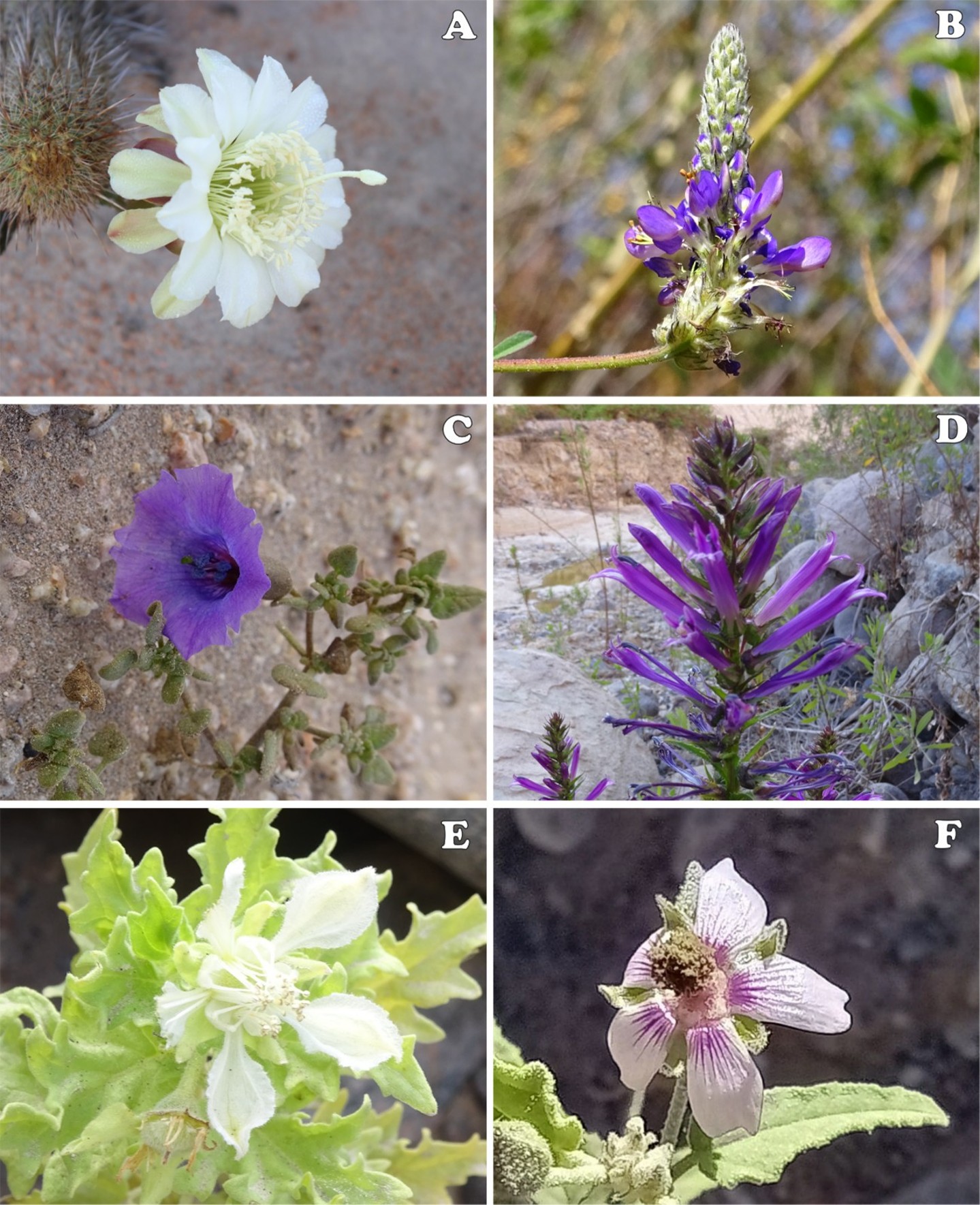
This study was conducted in the seasonally dry riparian forest located in the Jaguay-Manga-Pachana ravine, which spans the provinces of Camaná and Condesuyos in the Arequipa region, Peru. The evaluated area, approximately 1,268 hectares in extent, includes riparian ecosystems. The general objective was to characterize the flora and vegetation of the study area through intensive botanical surveys and quantitative plot-based vegetation assessment. Field sampling was carried out between 2022 and 2024, during which 57 vascular plant species were recorded, distributed in 53 genera and 25 families. The vegetation types identified were lomas, sparsely vegetated desert, riparian woodland, agricultural area, and cardonal; among them, the riparian woodland was the most representative unit, dominated by formations of Vachellia macracantha (“huarango”), together with important species such as Schinus molle (“molle”) and Tecoma fulva subsp. arequipensis (“cahuato”). Within the sensitive flora, seven endemic species were recorded, five categorized under Supreme Decree No. 043-2006-AG, 21 included in the IUCN Red List, and four listed in Appendix II of CITES. This study seeks to support the inclusion of these forests in Peru’s sectoral list of fragile ecosystems in order to ensure their conservation.
References
Acuña, R., & Weigend, M. (2017). A taxonomic revision of the western South American genus Presliophytum (Loasaceae). Phytotaxa, 329(1). https://doi.org/10.11646/phytotaxa.329.1.3
Andaluz, C. (2003). Política y legislación para promover la lucha contra la desertificación y la pobreza en los bosques secos BT - I Congreso Internacional de Bosques Secos.
Chicalla-Rios, K. J. (2017). Adiciones a la flora y vegetación del departamento de Moquegua, Perú: cuencas del río Moquegua, río Tambo y quebradas costeras. Revista Ciencia y Tecnología para el desarrollo, 3(6), 36–54. https://doi.org/10.37260/rctd.v3i6.91
Cuba-Cordova, Z. M., Loayza-Vargas, D., & Huamantupa-Chuquimaco, I. (2023). Diversidad, estructura y estado sanitario de las poblaciones de los bosques de Huarangales en el valle de Ica, sur peruano. GENTRYANA, 2(1), 46–61. https://doi.org/10.55873/gentryana.v2i1.245
Depenthal, J., & Meitzner Yoder, L. S. (2017). Community Use and Knowledge of Algarrobo (Prosopis pallida) and Implications for Peruvian Dry Forest Conservation. Revista de Ciencias Ambientales, 52(1), 49. https://doi.org/10.15359/rca.52-1.3
Franco León, J., Cáceres Musaja, C., & Sulca Quispe, L. (2019). Flora y vegetación del departamento de Tacna. Ciencia & Desarrollo, 8, 23–30. https://doi.org/10.33326/26176033.2004.8.143
Holdridge, L. R. (1967). Life zone ecology. Tropical Science Center.
Linares-Palomino, R. (2004a). Los bosques tropicales estacionalmente secos: I. El concepto de los bosques secos en el Perú. Arnaldoa, 11(1), 85–102.
Linares-Palomino, R. (2004b). Los bosques tropicales estacionalmente secos: II. Fitogeografía y composición florística. Arnaldoa, 11(1), 103–138.
Linares-Palomino, R., Huamantupa-Chuquimaco, I., Padrón, E., La Torre-Cuadros, M. de los Á., Roncal-Rabanal, M., Choquecota, N., Collazos, L., Elejalde, R., Vergara, N., & Marcelo Peña, J. L. (2022). Los bosques estacionalmente secos del Perú. Revista Peruana de Biología, 29(4), e21613. https://doi.org/10.15381/rpb.v29i4.21613
MINAM. (2015a). Guía de inventario de la flora y vegetación. Ministerio del Ambiente.
MINAM. (2015b). Mapa nacional de cobertura vegetal: Memoria descriptiva. Ministerio del Ambiente.
MINAM. (2018). Mapa nacional de ecosistemas del Perú: Memoria descriptiva. Ministerio del Ambiente.
Quipuscoa, V., Balvin, M., Treviño, I., Sinca, F., Bedoya, M., Rosado, G., & Huamaní, S. (2022). Plantas vasculares endémicas de Arequipa – Perú. Editorial UNSA.
Sanchez-Azofeifa, A., Kalacska, M., Quesada, M., Calvo-Alvarado, J., Nassar, J. M., & Rodríguez, J. (2005). Tropical dry forests: The most endangered tropical forest. In Seasonally dry tropical forests (pp. 285–288). University of Cambridge Press.
Sandweiss, D., Cano, A., Ojeda, B., & Roque, J. (1999). Pescadores paleoíndios del Perú. Investigación y Ciencia, 2–8.
Sebastianelli, A., Spiller, D., Carmo, R., Wheeler, J., Nowakowski, A., Jacobson, L. V., Kim, D., Barlevi, H., Cordero, Z. E. R., Colón-González, F. J., Lowe, R., Ullo, S. L., & Schneider, R. (2024). A reproducible ensemble machine learning approach to forecast dengue outbreaks. Scientific Reports, 14(1), 3807. https://doi.org/10.1038/s41598-024-52796-9
SERFOR. (2019). Restauración de paisajes en el Perú: Sitios prioritarios y evaluación de oportunidades. SERFOR.
Siyum, Z. G. (2020). Tropical dry forest dynamics in the context of climate change: Syntheses of drivers, gaps, and management perspectives. Ecological Processes, 9, 25. https://doi.org/10.1186/s13717-020-00231-1
Smith, K. F., & Guégan, J.-F. (2010). Changing Geographic Distributions of Human Pathogens. Annual Review of Ecology, Evolution, and Systematics, 41(1), 231–250. https://doi.org/10.1146/annurev-ecolsys-102209-144634
Stan, K., & Sanchez-Azofeifa, A. (2019). Tropical Dry Forest Diversity, Climatic Response, and Resilience in a Changing Climate. Forests, 10(5), 443. https://doi.org/10.3390/f10050443
UNEP-WCMC. (2024). The Checklist of CITES Species Website. CITES Secretariat. https://checklist.cites.org/#/en
Weberbauer, A. (1945). El mundo vegetal de los Andes peruanos. Estudio fitogeográfico. Estación Experimental Agrícola de La Molina.
Whaley, O., Orellana, A., Pérez, E., Tenorio, M., Quinteros, F., Mendoza, M., & Pecho, O. (2010). Plantas y vegetación de Ica, Perú: Un recurso para su restauración y conservación. Royal Botanic Gardens, Kew / Darwin Initiative.
Downloads
Published
Issue
Section
License
Copyright (c) 2026 Miguel Angel Hinojosa-Talavera, Lizbeth Angélica Lima-Salazar, Alejandro Delgado-Cárdenas

This work is licensed under a Creative Commons Attribution 4.0 International License.
The authors, knowing that the GENTRYANA journal has an Open Access policy (Open Access) accept the conditions of the Creative Commons Attribution 4.0 International LICENSE (CC BY 4.0).