Composición y Diversidad de la Flora Leñosa en el Bosque de Tierra Firme del Fundo El Bosque - UNAMAD, Madre de Dios, Perú
DOI:
https://doi.org/10.55873/gentryana.v3i2.436Palabras clave:
Amazonía peruana, bosque de tierra firme, composición florística, diversidad alfa, diversidad betaResumen
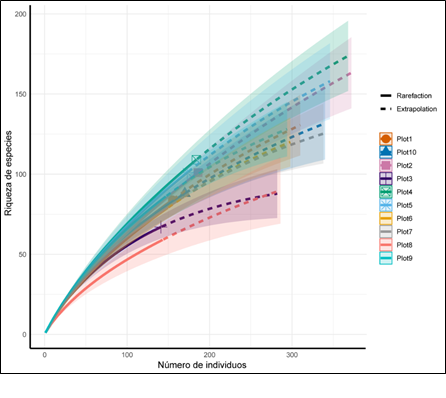
Los bosques de tierra firme de la Amazonía occidental albergan algunos de los niveles más altos de diversidad vegetal del planeta; sin embargo, los patrones locales de composición y diversidad florística aún son pocos y estudiarlos es importante, más aún porque estas áreas presentan severas amenazas y problemáticas ambientales. El presente estudio tuvo como objetivo evaluar la composición y diversidad de la flora leñosa en el bosque de tierra firme del Fundo El Bosque-UNAMAD, en la región Madre de Dios, Perú. Se evaluaron aleatoriamente diez parcelas de 0,1 ha (20 × 50 m), donde se registraron todos los individuos leñosos con diámetro a la altura del pecho (DAP) ≥ 2,5 cm. La composición florística fue analizada mediante identificaciones taxonómicas, mientras que para la diversidad se aplicaron índices Alfa de Fisher, Chao-1, curvas de rarefacción y análisis de diversidad beta mediante análisis de Cluster y NMDS. Se registraron 1617 individuos pertenecientes a 397 especies, 175 géneros y 59 familias. Las familias con mayor riqueza fueron: Lauraceae (42 especies), Fabaceae (41), Sapotaceae (28); los géneros más diversos fueron Inga, Ocotea y Pouteria, y las especies más abundantes fueron: Siparuna decipiens y Euterpe precatoria. La diversidad alfa presentó valores elevados (mayores a 100 de Alfa Fisher), con promedios de 76,53. La diversidad beta mostró similitudes moderadas entre parcelas (30–45%), evidenciando un importante recambio florístico. Los resultados confirman que el Fundo El Bosque constituye un importante reservorio de biodiversidad amazónica y evidencian la influencia de la heterogeneidad ambiental local sobre los patrones de composición y diversidad de la flora leñosa.
Referencias
Angiosperm Phylogeny Group (APG-IV). (2016). An update of the Angiosperm Phylogeny Group classification for the orders and families of flowering plants: APG IV. Botanical Journal of the Linnean Society, 181(1), 1–20. https://doi.org/10.1111
Araujo-Murakami, A., Poma-Chura, A., Palabral, A., Salvatierra, R., & Hurtado, F. (2012). Composición florística de los bosques amazónicos de tierra firme e inundable en las proximidades de las pampas del Sonene (Río Heath), Parque Nacional Madidi, Bolivia. Kempffiana, 8(1), 3–21. https://doi.org/ISSN: 1991-4652
Araujo-Murakami, A., Villarroel, D., Pardo, G., Vos, V., Parada, A., Arroyo, L., & Killeen, T. (2015). Diversidad arbórea de los bosques de tierra firme de la Amazonía boliviana. Kempffiana, 11(1), 1–28.
Carhuarupay, S. (2014). “Estructura, diversidad y composición florística arbórea de un bosque de terraza alta del sector Loboyoc, Distrito de Las Piedras, Provincia de Tambopata, Madre de Dios. Universidad Nacional Amazónica de Madre de Dios.
Chao, A. (1987). Estimating the Population Size for Capture-Recapture Data with Unequal Catchability.
Dueñas, H. (2021). Los bosques de la Amazonía peruana: biodiversidad, ecosistema, políticas y normas (I. L. de A. E. ILAE (ed.)). Instituto Latinoamericano de Altos Estudios –ILAE.
Dueñas, H., Peña, J., Báez, S., Bejar, N. B., Berrocal, N., & Garate, J. (2019). Influencia de la conservación de bosques en la diversidad y composición florística arbórea en el sureste de la Amazonía peruana. Ciencia Amazónica (Iquitos), 7(1), 111–125. http://dx.doi.org/10.22386/ca.v7i1.268
Encarnación, F., Zarate, R., & Ahuite, M. (2008). Temática Vegetación en la Zonificación Ecológica y Económica (ZEE) del departamento de Madre de Dios.
Escalante, A. (2019). Riqueza, dominancia, diversidad y composición floristica de arboles en la localidad de Loboyoc, Tambopata-Madre de Dios. Universidad nacional amazonica de madre de dios.
Gentry, A. H. (1988). Changes in plant community diversity and floristic composition on environmental and geographical gradients. Annals Missouri Botanical Garden, 75(1), 1–34. http://www.jstor.org/stable/2399464
Gentry, A. H., & Ortiz, R. (1993). Patrones de composición florística en la Amazonía peruana. In R. Kalliola, M. Puhakka, & W. Danjoy (Eds.), Amazonia peruana vegetación húmeda tropical en el llano subandino (pp. 155–166). https://doi.org/9529043872
Hsieh, T. C., Ma, K. H., & Chao, A. (2016). An R package for rarefaction and extrapolation of species diversity (Hill numbers). In Methods in Ecology and Evolution (pp. 1451–1456).
INADE, (2007). Mesozonificación Ecológica-Económica del Corredor Interoceánico Sur, tramo Iñapari – Inambari. Instituto Nacional de Desarrollo (INADE), proyecto especial de Madre de Dios y proyecto de Estudios Automatizados Especializados – PEASE, Puerto Maldonado – Perú.
Oksanen, J., Simpson, G. L., Blanchet, F. G., Kindt, R., & Weedon, J. (2022). Vegan:Community Ecology Package. (R Package Version 2; pp. 6–2). https://cran.r-project.org/package=vegan.
Phillips, O., Baker, T., Feldpausch, T., & Roel, B. (2016). Manual de campo para el establecimiento y la remedición de parcelas. In Rainfor. https://forestplots.net/upload/es/recursos/RAINFOR_field_manual_ES.pdf
Phillips, O., & Miller, J. (2002). Global patterns of plant diversity: Alwyn H. Gentry’s forest transect data set. Missouri Botanical Garden Press, 89. https://doi.org/10.1007/s00606-004-0211-6
Phillips, O. L., Núñez Vargas, P., Monteagudo, A. L., Peña Cruz, A., Chuspe Zans, M. E., Galiano Sánchez, W., Yli-Halla, M., & Rose, S. (2003). Habitat association among Amazonian tree species: A landscape-scale approach. Journal of Ecology, 91(5), 757–775. https://doi.org/10.1046/j.1365-2745.2003.00815.x
Pitman, N., Terbogh, J., Silman, M., Nuñez, P., Neill, D., Cerón, C., Palacios, W., & Aulestia, M. (2001). Dominance and distribution of tree species in upper amazonian terra firme forests. Ecological Society of America, 82(8), 2101–2117.
R Development Core Team. (2024). A Language and Environment for Statistical Computing; R Foundation for Statistical ComputingNo Title. https://doi.org/ISBN 3-900051-07-0
Tuomisto H, Ruokolainen K, Yli-Halla M. (2003). Dispersal, environment, and floristic variation of western Amazonian forests. Science 299, 241–244. (doi:10.1126/science.1078037)
Descargas
Publicado
Número
Sección
Licencia
Derechos de autor 2024 Nicole Eliane Vasquez-Bravo, Cristian Jhordi Pumalloclla De Souza, Williams Navarro-Mendoza, Hugo Brito Ccopa-Huayta, Sharon Pamela Olarte-Año, Yurema Clotilda Miranda-Aquino, Yoni Flora Fernández-Herrera, Hector Quispe-Solis

Esta obra está bajo una licencia internacional Creative Commons Atribución 4.0.
Los autores, en conocimiento que la revista GENTRYANA tiene una política de Acceso Abierto (Open Access) aceptan las condiciones de la LICENCIA Creative Commons Atribución 4.0 Internacional (CC BY 4.0).