Español
DOI:
https://doi.org/10.55873/gentryana.v4i1.419Keywords:
ACR Chuyapi Urusayhua, relict forest, geomorphological depression, PodocarpaceaeAbstract
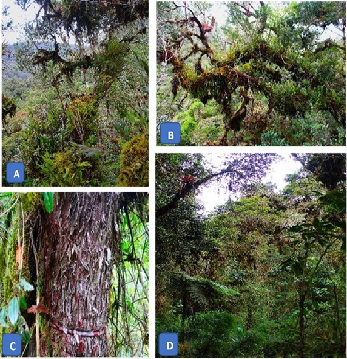
The first record of a relict forest dominated by Podocarpus oleifolius is reported in the Chuyapi Urusayhua Regional Conservation Area (Cusco, Peru), located in a high-Andean depression of as-yet-unreported origin between 2800 and 3200 meters above sea level. Six plots (50 x 20 m) were established, where 35–48 adult individuals were recorded per plot, with a diameter at breast height (DBH) of 27–80 cm, heights of 12–18 m, and estimated ages of 400–700 years. P. oleifolius exhibits clear dominance within the crater, covering more than 1000 hectares. This finding expands the known distribution of this species in southern Peru and highlights the biogeographical and conservation importance of the site.
References
Farfan-Rios, W., Garcia-Cabrera, K., Salinas, N., Raurau-Quisiyupanqui, M. N., & Silman, M. R. (2015). Lista anotada de árboles y afines en los bosques montanos del sureste peruano: la importancia de seguir recolectando. Revista Peruana de Biología, 22(2), 145-174. https://doi.org/10.15381/rpb.v22i2.11351
Gobierno regional del Cusco. (2022). Plan Maestro del Area de Conservación Regional Chuyapi Urusayhua (p. 77). https://sis.sernanp.gob.pe/biblioteca/?publicacion=2643
Hewitt, G. M. (2004). Genetic consequences of climatic oscillations in the Quaternary. Trends in Ecology & Evolution, 19(1). https://doi.org/10.1016/j.tree.2003.10.001
Hooghiemstra, H., & Van der Hammen, T. (2004). Quaternary Ice-Age dynamics in the Colombian Andes: developing an understanding of our legacy. Philosophical Transactions of the Royal Society of London. Series B: Biological Sciences, 359(1442), 173-181. https://doi.org/10.1098/rstb.2003.1420
Huamantupa Chuquimaco, I., Luza-Victorio, M., Alfaro Curitumay, L. Ururi, M., Huaman Arque, W. Pedraza, M., & Peralvo, M. (2019). Diversidad y Biomasa Arbórea en los Bosques Andinos del Santuario Nacional del Ampay, Apurímac – Perú. Q’EUÑA, 8(1), 7-26. https://doi.org/10.51343/rq.v8i1.104
Khan, R., Hill, R. S., Liu, J., & Biffin, E. (2023). Diversity, Distribution, Systematics and Conservation Status of Podocarpaceae. Plants, 12(5), 1171. https://doi.org/10.3390/plants12051171
MINAM. (2019). GEO GPS PERÚ. geogpsperu.com/2019/04/mapa-de-ecosistemas-del-peru-descargar.html
Ministerio del Ambiente. (2015). Guia de inventario de flora y vegetacion. chrome-extension://efaidnbmnnnibpcajpcglclefindmkaj/https://cdn.www.gob.pe/uploads/document/file/12082/07_guia-a-de-flora-y-vegetacion.pdf?v=1530548605
Ramírez-Peralta, J. A., Salazar-Hinostroza, E. J., Baselly-Villanueva, J. R., Huayta-Hinojosa, L. D., & Huamantupa-Chuquimaco, I. (2025). Leaf morphometry of six Podocarpaceae species from Peru: A contribution to their taxonomic identification. Lilloa, 369-398. https://doi.org/10.30550/j.lil/2160
SERNANP. (2019). Plan Maestro del Santuario Nacional Ampay 2019–2029. https://www.gob.pe/institucion/sernanp/informes-publicaciones/1928581-santuario-nacional-de-ampay
Speer, J. H. (2012). Fundamentals of Tree Ring Research. The University of Arizona Press.
Vicuña Miñano, E. E. (2005). Las Podocarpáceas de los bosques montanos del noroccidente peruano. Revista Peruana de Biología, 12(2). http://www.scielo.org.pe/scielo.php?pid=S1727-99332005000200011&script=sci_abstract
Downloads
Published
How to Cite
Issue
Section
License
Copyright (c) 2025 Alwin Leonardo Huillca Tapara, Emanuel Carazas huaman

This work is licensed under a Creative Commons Attribution 4.0 International License.
The authors, knowing that the GENTRYANA journal has an Open Access policy (Open Access) accept the conditions of the Creative Commons Attribution 4.0 International LICENSE (CC BY 4.0).