Water quality monitoring for rural areas using a low-cost IoT-based sensor system
DOI:
https://doi.org/10.55873/apd27r75Keywords:
environmental monitoring, embedded systems, unsupervised learning, physicochemical sensors, rural areasAbstract
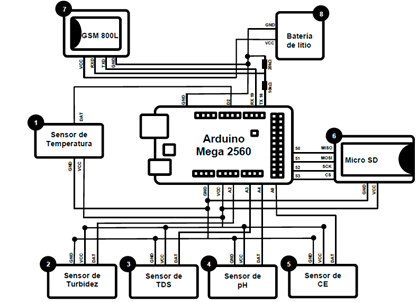
Limited access to continuous water quality monitoring technologies in rural areas hinders efficient water resource management and exposes the population to health risks. This study presents the design and implementation of a monitoring system based on low-cost sensors integrated into an Internet of Things (IoT) architecture, capable of real-time data transmission. The research was conducted in the rural community of Chuina, located in the Morales district of the San Martín region, Peru. An embedded system based on Arduino Mega was implemented, integrating sensors for pH, turbidity, temperature, total dissolved solids, and electrical conductivity, alongside communication and storage modules. A total of 2,880 automatic readings were collected over a 60-day monitoring period. The results showed that physicochemical parameters generally remained within regulatory limits; patterns were identified using descriptive statistics and K-Means unsupervised learning models. The study concludes that the system operates robustly and reliably, offering a replicable alternative for rural areas with limited infrastructure and serving as a useful tool for strengthening environmental monitoring.
Downloads
References
Al-Kassab-Córdova, A., Silva-Perez, C., Robles-Valcarcel, P., Bendezu-Quispe, G., Ortiz, A. I., & Benites-Zapata, V. A. (2023). Spatial and socioeconomic inequalities in the access to safe drinking water in Peruvian households. Journal of Water and Health, 21, 525–535. https://doi.org/10.2166/wh.2023.316
Amador-Castro, F., González-López, M. E., Lopez-Gonzalez, G., Garcia-Gonzalez, A., Díaz-Torres, O., Carbajal-Espinosa, O., & Gradilla-Hernández, M. S. (2024). Internet of Things and citizen science as alternative water quality monitoring approaches and the importance of effective water quality communication. Journal of Environmental Management, 352, 119959. https://doi.org/10.1016/j.jenvman.2023.119959
Arsene, D., Predescu, A., Pahonțu, B., Chiru, C. G., Apostol, E.-S., & Truică, C.-O. (2022). Advanced strategies for monitoring water consumption patterns in households based on IoT and machine learning. Water, 14, 2187. https://doi.org/10.3390/w14142187
Autoridad Nacional del Agua. (s. f.). ANA optimiza la gestión ambiental de los vertimientos por ríos más saludables en el Perú. Gobierno del Perú.
Carvalho, A. K. N. D., Souza, R. F. D., & De Oliveira, S. D. S. (2022). Qualidade de águas superficiais e subterrâneas para irrigação em um município do semiárido do estado do Rio Grande do Norte. Pesquisas em Geociências, 49, e119720. https://doi.org/10.22456/1807-9806.119720
Fondo de las Naciones Unidas para la Infancia. (s. f.). La triple amenaza: La combinación de las enfermedades, los riesgos climáticos y la precariedad de los servicios de agua, saneamiento e higiene puede tener repercusiones mortales para la infancia. UNICEF.
Ghachoui, E., Taouil, H., Naser, R. S. M., & Said, I. A. (2024). Spatial assessment of groundwater quality for drinking in Souk El Arbaa, Morocco. Water Supply, 24, 1267–1281. https://doi.org/10.2166/ws.2024.059
Gomes, R., Pereira, C., Galvão, J., & Ribeiro, V. (2024). Drinking water: Strategies for sustainable management and water for everyone. En J. R. D. C. S. Galvão, P. Brito, F. D. S. Neves, H. D. A. Almeida, S. D. J. M. Mourato, & C. Nobre (Eds.), Proceedings of the 3rd International Conference on Water Energy Food and Sustainability (ICoWEFS 2023) (pp. 709–715). Springer Nature Switzerland.
Gupta, M., Tanwar, S., & Jain, V. (2023). Potential of IoT for water monitoring to upgrade food quality. En A. E. Hassanien & M. Soliman (Eds.), Artificial intelligence: A real opportunity in the food industry (Vol. 1000, pp. 119–139). Springer International Publishing.
Instituto Nacional de Estadística e Informática. (s. f.). Perú: Formas de acceso al agua y saneamiento básico.
Jabbar, W. A., Mei Ting, T., I. Hamidun, M. F., Che Kamarudin, A. H., Wu, W., Sultan, J., Alsewari, A. A., & Ali, M. A. H. (2024). Development of LoRaWAN-based IoT system for water quality monitoring in rural areas. Expert Systems with Applications, 242, 122862. https://doi.org/10.1016/j.eswa.2023.122862
Jaramillo Vera, E. N., & Marines Batalla, P. (2023). Enfermedades hídricas que afectan a la población como efecto del uso y consumo de agua disponible: Una mirada desde las acciones de enfermería. Más Vita. Revista de Ciencias de la Salud, 5, 29–43. https://doi.org/10.47606/ACVEN/MV0210
Karthikeyan, V., Visu, Y. P., & Kalaimannan, E. (2024). Smart system for wastewater treatment (SSWWT): Internet of Things (IoT)-based intelligent framework for society. En Sustainability principles and applications in engineering practice (pp. 57–77).
Kumar, D. S., Askarunisa, A., & Kumar, R. M. (2020). Embedded processor based automated assessment of quality of the water in an IoT background. Microprocessors and Microsystems, 77, 103167. https://doi.org/10.1016/j.micpro.2020.103167
Lal, K., Menon, S., Noble, F., & Arif, K. M. (2024). Low-cost IoT based system for lake water quality monitoring. PLOS ONE, 19, e0299089. https://doi.org/10.1371/journal.pone.0299089
Lu, Q., Zou, J., Ye, Y., & Wang, Z. (2024). Design and implementation of a Li River water quality monitoring and analysis system based on outlier data analysis. PLOS ONE, 19, e0299435. https://doi.org/10.1371/journal.pone.0299435
Montero Contreras, C. V. (2022). Impacto de los servicios de agua y saneamiento sobre las enfermedades diarreicas en los niños de la sierra del Perú. Revista de Análisis Económico y Financiero, 5, 1–8. https://doi.org/10.24265/raef.2022.v5n1.45
Nieto Pacheco, A. J., Villegas Pilay, Y. E., & Galarza Alay, J. I. (2023). Avances actuales de las IoT y sus diversas aplicaciones. ConcienciaDigital, 6, 58–74. https://doi.org/10.33262/concienciadigital.v6i1.2440
Organización Mundial de la Salud. (s. f.). Agua para consumo humano.
Paredes, C. L., & Woolley, K. (2022). ¿Agua para todos? Differences in access to clean water and a bathroom at home by ethno-racial characteristics in contemporary Peru. Sociology of Development, 8, 450–484. https://doi.org/10.1525/sod.2021.0044
Qian, P., & Liu, G. (2024). Application of high-frequency intelligent sensing network in monitoring and early warning of water quality dynamic change. International Journal of Computational Intelligence Systems, 17, 195. https://doi.org/10.1007/s44196-024-00605-6
Salgado, J., Pizarro, C., Wong, L., & Castillo, J. (2022). IoT Watercare: Water quality control system in unofficial settlements of Peru based in an IoT architecture. En 2022 31st Conference of Open Innovations Association (FRUCT) (pp. 277–288). IEEE.
Siren, S., Pec, R., Srun, C., Meas, S., Ny, V., Eang, S., & Sari, P. (2024). An IoT prototype for water quality monitoring system with case study in NPIC campus. International Journal of Electrical and Electronics Research, 12, 1407–1417. https://doi.org/10.37391/ijeer.120435
Sugiharto, W. H., Susanto, H., & Prasetijo, A. B. (2023). Real-time water quality assessment via IoT: Monitoring pH, TDS, temperature, and turbidity. International Journal of Safety and Security Engineering, 28, 823–831. https://doi.org/10.18280/isi.280403
Venkatesh, J., Partheeban, P., Baskaran, A., Krishnan, D., & Sridhar, M. (2024). Wireless sensor network technology and geospatial technology for groundwater quality monitoring. Journal of Industrial Information Integration, 38, 100569. https://doi.org/10.1016/j.jii.2024.100569
Downloads
Published
Issue
Section
License
Copyright (c) 2026 Andrea Alexandra Garcia-Gonzales, Cristian García-Estrella

This work is licensed under a Creative Commons Attribution 4.0 International License.