Information Management and Academic Effectiveness in Digital Higher Education: Evidence from Peruvian Engineering Students
DOI:
https://doi.org/10.55873/995r5j09Keywords:
digital competence, information literacy, learning outcomes, self-regulated learning, technology-mediated learningAbstract
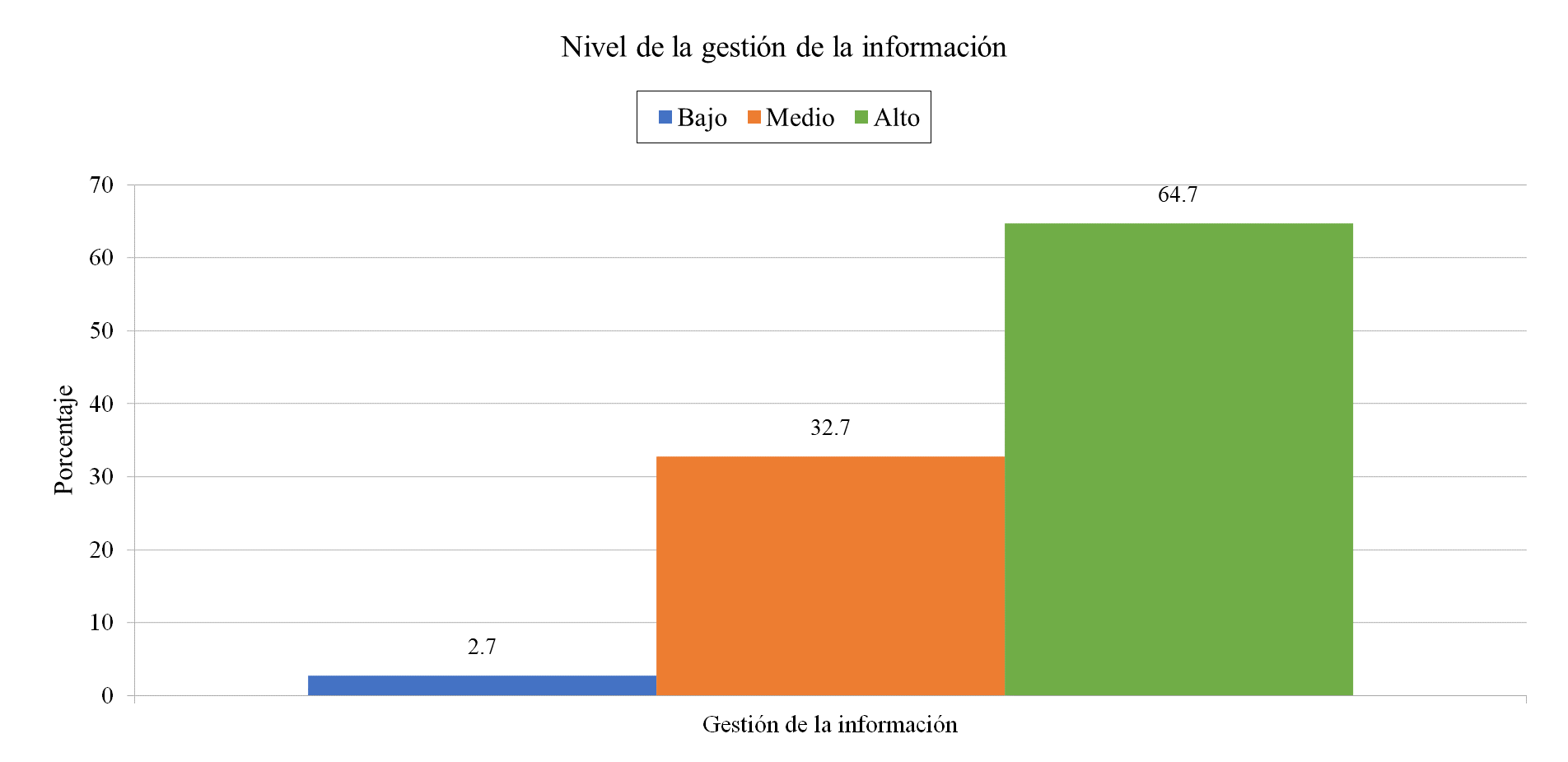
Digital higher education requires students to locate, evaluate, organize, and use academic information efficiently; this study determined the relationship between information management and academic effectiveness among 150 Civil Engineering students in Tarapoto, Peru, during 2026; a quantitative, basic, non-experimental, cross-sectional design was applied, using census sampling and two 18-item Likert questionnaires with Cronbach's alpha coefficients of .940 and .908; information management reached a high level in 64.70% of participants and academic effectiveness in 64.00%; because distributions were non-normal, Spearman's rho was used, showing a moderate positive relationship between both variables (rho = .513, p < .001), as well as significant associations for processes (rho = .764), capabilities (rho = .742), and structures (rho = .562); the findings indicate that stronger information management practices are linked to greater academic effectiveness without establishing causality.
Downloads
References
Araya, D. H., Muñoz, D. R., Pizarro, C. D., & Zapata, F. S. (2022). Elaboración y validación de cuestionario sobre la enseñanza y aprendizaje en educación remota. Educação e Pesquisa, 48, e256217. https://doi.org/10.1590/S1678-4634202248256217esp
Ashiq, M., Hira, A., & Saeed, A. (2026). The relationship between information literacy and academic performance: A meta-analysis study. Performance Measurement and Metrics, 27(1), 81-97. https://doi.org/10.1108/PMM-04-2025-0020
Blanchar Martínez, T. C., & Martínez Trujillo, N. E. (2024). ¿Entrevista o encuesta?: Una diferencia necesaria. Revista Latina de Comunicación Social, 83. https://doi.org/10.4185/rlcs-2025-2339
Calle Mollo, S. E. (2023). Diseños de investigación cualitativa y cuantitativa. Ciencia Latina Revista Científica Multidisciplinar, 7(4), 1865-1879. https://doi.org/10.37811/cl_rcm.v7i4.7016
Castillo-de-León, M. A., Méndez-Hinojosa, L. M., & Cárdenas-Rodríguez, M. (2024). Development and psychometric validation of an information competency assessment: The Information Management Brief Scale. European Journal of Educational Research, 13(2), 619-630. https://doi.org/10.12973/eu-jer.13.2.619
Chávez Esponda, D., & Morell Pérez, L. (2024). Experiencias con el uso del SPSS en las clases virtuales de Estadística. Prohominum, 6(3), 68-81. https://doi.org/10.47606/acven/ph0262
Colina-Ysea, F., Pantigoso-Leython, N., Abad-Lezama, I., Calla-Vásquez, K., Chávez-Campó, S., Sanabria-Boudri, F. M., & Soto-Rivera, C. (2024). Implementation of hybrid education in Peruvian public universities: The challenges. Education Sciences, 14(4), 419. https://doi.org/10.3390/educsci14040419
Deci, E. L., & Ryan, R. M. (1985). Intrinsic motivation and self-determination in human behavior. Springer. https://doi.org/10.1007/978-1-4899-2271-7
Flores-Pérez, Y. B., Vásquez-Alburqueque, I. L., Cango Córdova, J. I., & Reto Gómez, J. (2025). Estrategias de gestión de la información para fortalecer la producción científica en trabajo social. Revista Venezolana de Gerencia, 30(Especial 13), 134-149. https://doi.org/10.52080/rvgluz.30.especial13.9
Godsk, M., & Møller, K. L. (2025). Engaging students in higher education with educational technology. Education and Information Technologies, 30, 2941-2976. https://doi.org/10.1007/s10639-024-12901-x
Hinojosa Mamani, J., Mamani Gamarra, J. E., Jilaja Carita, E. E., Albarracín Machicado, F. D., & Zela Paricahua, M. (2023). Technological infrastructure and competency-based learning in university higher education, Puno-Peru. LATAM Revista Latinoamericana de Ciencias Sociales y Humanidades, 4(2), 5354-5368. https://doi.org/10.56712/latam.v4i2.986
Liu, L., Wang, S., Chen, J., Li, H., Gui, J., & Zhang, R. (2025). Information literacy of higher vocational college students in digital age. Journal of Librarianship and Information Science, 57(2), 539-550. https://doi.org/10.1177/09610006231224445
Manterola, C., Hernández-Leal, M. J., Otzen, T., Espinosa, M. E., & Grande, L. (2023). Estudios de corte transversal: Un diseño de investigación a considerar en ciencias morfológicas. International Journal of Morphology, 41(1), 146-155. https://doi.org/10.4067/S0717-95022023000100146
Mena-Guacas, A. F., López-Catalán, L., Bernal-Bravo, C., & Ballesteros-Regaña, C. (2025). Educational transformation through emerging technologies: Critical review of scientific impact on learning. Education Sciences, 15(3), 368. https://doi.org/10.3390/educsci15030368
Montesinos Murillo, S. M., Holgado Tejada, L. D., & Rozas Calderón, V. (2024). Recursos digitales educativos para estudiantes universitarios. Horizontes, 8(35), 2277-2286. https://doi.org/10.33996/revistahorizontes.v8i35.868
Mucha Hospinal, L. F., Chamorro Mejía, R., Oseda Lazo, M. E., & Alania-Contreras, R. D. (2021). Evaluación de procedimientos empleados para determinar la población y muestra en trabajos de investigación de posgrado. Desafíos, 12(1), 50-57. https://doi.org/10.37711/desafios.2021.12.1.253
Nikou, S., & Aavakare, M. (2021). An assessment of the interplay between literacy and digital technology in higher education. Education and Information Technologies, 26, 3893-3915. https://doi.org/10.1007/s10639-021-10451-0
Núñez Rojas, N., Matas Terrón, A., Ríos Ariza, J. M., & Llatas Altamirano, L. J. (2024). Competencias digitales en estudiantes universitarios: Análisis de las condiciones tecnológicas de la educación superior. Revista de Ciencias Sociales, 30, 243-256. https://doi.org/10.31876/rcs.v30i.42841
Okoye, K., Hussein, H., Arrona-Palacios, A., Quintero, H. N., Ortega, L. O. P., Sanchez, A. L., Ortiz, E. A., Escamilla, J., & Hosseini, S. (2023). Impact of digital technologies upon teaching and learning in higher education in Latin America: An outlook on the reach, barriers, and bottlenecks. Education and Information Technologies, 28, 2291-2360. https://doi.org/10.1007/s10639-022-11214-1
Orellana Malla, A. K. (2024). Eficacia educativa: Una revisión sistemática sobre la realidad universitaria. Ciencia Latina Revista Científica Multidisciplinar, 8(4), 11103-11121. https://doi.org/10.37811/cl_rcm.v8i4.13246
Ortiz-Barba, A., Regalado-Hualca, T., & Suarez-Pérez, J. (2025). Influencia del limitado acceso a la tecnología en el desarrollo académico y emocional de los estudiantes en el contexto COVID-19 en Ecuador. 593 Digital Publisher CEIT, 10(1), 415-427. https://doi.org/10.33386/593dp.2025.1.2725
Osada, J., & Salvador-Carrillo, J. (2021). Estudios descriptivos correlacionales: ¿término correcto? Revista Médica de Chile, 149(9), 1383-1384. https://doi.org/10.4067/S0034-98872021000901383
Quiñones-Negrete, M. M., Martin-Cuadrado, A. M., & Coloma-Manrique, C. R. (2021). Rendimiento académico y factores educativos de estudiantes del programa de educación en entorno virtual: Influencia de variables docentes. Formación Universitaria, 14(3), 25-36. https://doi.org/10.4067/S0718-50062021000300025
Rojas Maldonado, E. R., & Toscano Galeana, J. (2025). Instrumento para la evaluación de la satisfacción del aprendizaje: Diseño, validación y análisis psicométrico de una escala Likert. Dilemas Contemporáneos: Educación, Política y Valores. https://doi.org/10.46377/dilemas.v13i1.4743
Shi, Y. (2022). Research on university information management based on nonlinear matrix organizational structure. Mathematical Problems in Engineering, 2022, 9964513. https://doi.org/10.1155/2022/9964513
Smith, E. E., & Storrs, H. (2023). Digital literacies, social media, and undergraduate learning: What do students think they need to know? International Journal of Educational Technology in Higher Education, 20, 29. https://doi.org/10.1186/s41239-023-00398-2
Tachie-Donkor, G., & Ezema, I. J. (2023). Effect of information literacy skills on university students' information seeking behaviour and lifelong learning. Heliyon, 9(8), e18427. https://doi.org/10.1016/j.heliyon.2023.e18427
Vieriu, A. M., & Petrea, G. (2025). The impact of artificial intelligence on students' academic development. Education Sciences, 15(3), 343. https://doi.org/10.3390/educsci15030343
Wong, A., Leong Lee, W., Liang Chan, M. S., Tan Yi En, Kheng Huang, J. M., & Haur Lee, Y. (2025). Digital learning resources and student success: Analyzing engagement and academic performance. Journal of Applied Learning & Teaching, 8(Special Issue 2). https://doi.org/10.37074/jalt.2025.8.S2.3
Yallico, R., Arones, M., & Aquije, R. (2024). Aprendizaje invertido y gestión de la información académica en estudiantes universitarios de Ica, Perú. Revista Innova Educación, 6(1), 37-49. https://doi.org/10.35622/j.rie.2024.01.003
Zamiri, M., & Esmaeili, A. (2024). Strategies, methods, and supports for developing skills within learning communities: A systematic review of the literature. Administrative Sciences, 14(9), 231. https://doi.org/10.3390/admsci14090231
Zimmerman, B. J. (2002). Becoming a self-regulated learner: An overview. Theory Into Practice, 41(2), 64-70. https://doi.org/10.1207/s15430421tip4102_2
Zou, Y., Kuek, F., Feng, W., & Cheng, X. (2025). Digital learning in the 21st century: Trends, challenges, and innovations in technology integration. Frontiers in Education, 10, 1562391. https://doi.org/10.3389/feduc.2025.1562391
Downloads
Published
Issue
Section
License
Copyright (c) 2026 Axl Enrique Navarro-García, Gabriela Alexandra Caro-García, María García-Paredes, Erick Arnold Saavedra-Ruiz, Jhosep Sánchez-Flores

This work is licensed under a Creative Commons Attribution 4.0 International License.