Artificial Intelligence and Academic Performance in Higher Education Students: Evidence from the Puno Region, Peru
Keywords:
digital literacy, machine learning, digital devices, educational ethics, open-source technologyAbstract
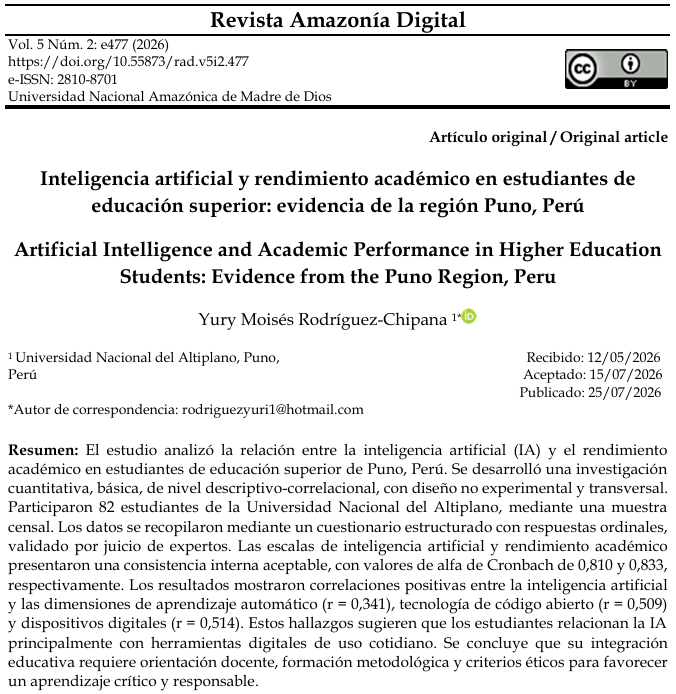
This study analyzed the relationship between artificial intelligence (AI) and academic performance among higher education students in Puno, Peru. A basic quantitative study was conducted using a descriptive-correlational approach with a non-experimental, cross-sectional design. The study included a census sample of 82 students from the National University of the Altiplano. Data were collected using a structured questionnaire with ordinal response options, validated through expert judgment. The artificial intelligence and academic performance scales demonstrated acceptable internal consistency, with Cronbach's alpha values of 0.810 and 0.833, respectively. The results showed positive correlations between artificial intelligence and the dimensions of machine learning (r = 0.341), open-source technology (r = 0.509), and digital devices (r = 0.514). These findings suggest that students primarily associate AI with digital tools used in everyday academic activities. The study concludes that integrating AI into higher education requires teacher guidance, methodological training, and ethical considerations to foster critical and responsible learning.
Downloads
References
Akgun, S., & Greenhow, C. (2022). Artificial intelligence in education: Addressing ethical challenges in K-12 settings. AI and Ethics, 2(3), 431–440. https://doi.org/10.1007/s43681-021-00096-7
Baker, R. S., & Inventado, P. S. (2014). Educational Data Mining and Learning Analytics. In Learning Analytics (pp. 61–75). Springer New York. https://doi.org/10.1007/978-1-4614-3305-7_4
Baker, T., Smith, L., & Anissa, N. (2019). Educ-AI-tion rebooted? Exploring the future of artificial intelligence in schools and colleges. https://www.nesta.org.uk/report/education-rebooted/
Castrillón, O. D., Sarache, W., & Ruiz-Herrera, S. (2020). Predicción del rendimiento académico por medio de técnicas de inteligencia artificial. Formación Universitaria, 13(1), 93–102. https://doi.org/10.4067/S0718-50062020000100093
Chen, L., Chen, P., & Lin, Z. (2020). Artificial Intelligence in Education: A Review. IEEE Access, 8, 75264–75278. https://doi.org/10.1109/ACCESS.2020.2988510
Crompton, H., & Burke, D. (2023). Artificial intelligence in higher education: the state of the field. International Journal of Educational Technology in Higher Education, 20(1), 22. https://doi.org/10.1186/s41239-023-00392-8
Dwivedi, Y. K., Kshetri, N., Hughes, L., Slade, E. L., Jeyaraj, A., Kar, A. K., Baabdullah, A. M., Koohang, A., Raghavan, V., Ahuja, M., Albanna, H., Albashrawi, M. A., Al-Busaidi, A. S., Balakrishnan, J., Barlette, Y., Basu, S., Bose, I., Brooks, L., Buhalis, D., … Wright, R. (2023). Opinion Paper: “So what if ChatGPT wrote it?” Multidisciplinary perspectives on opportunities, challenges and implications of generative conversational AI for research, practice and policy. International Journal of Information Management, 71, 102642. https://doi.org/10.1016/j.ijinfomgt.2023.102642
Farrokhnia, M., Banihashem, S. K., Noroozi, O., & Wals, A. (2024). A SWOT analysis of ChatGPT: Implications for educational practice and research. Innovations in Education and Teaching International, 61(3), 460–474. https://doi.org/10.1080/14703297.2023.2195846
Hernández Sampieri, R., Fernández Collado, C., & Baptista Lucio, P. (2014). Metodología de la Investigación. McGrawHIll Education.
Holmes, W., Bialik, M., & Fadel, C. (2019). Artificial Intelligence in Education. Promise and Implications for Teaching and Learning. Center for Curriculum Redesign.
Kasneci, E., Sessler, K., Küchemann, S., Bannert, M., Dementieva, D., Fischer, F., Gasser, U., Groh, G., Günnemann, S., Hüllermeier, E., Krusche, S., Kutyniok, G., Michaeli, T., Nerdel, C., Pfeffer, J., Poquet, O., Sailer, M., Schmidt, A., Seidel, T., … Kasneci, G. (2023). ChatGPT for good? On opportunities and challenges of large language models for education. Learning and Individual Differences, 103, 102274. https://doi.org/10.1016/j.lindif.2023.102274
Luckin, R., Holmes, W., Griffiths, M., & Forcier, L. B. (2016). Intelligence Unleashed: An argument for AI in Education. Pearson.
Ocaña-Fernández, Y., Valenzuela-Fernández, L. A., & Garro-Aburto, L. L. (2019). Inteligencia artificial y sus implicaciones en la educación superior. Propósitos y Representaciones, 7(2). https://doi.org/10.20511/pyr2019.v7n2.274
Ouyang, F., & Jiao, P. (2021). Artificial intelligence in education: The three paradigms. Computers and Education: Artificial Intelligence, 2, 100020. https://doi.org/10.1016/j.caeai.2021.100020
Romero, C., & Ventura, S. (2020). Educational data mining and learning analytics: An updated survey. WIREs Wiley Interdisciplinary Reviews, 10(3). https://doi.org/https://doi.org/10.1002/widm.1355
Siemens, G. (2013). Learning Analytics. American Behavioral Scientist, 57(10), 1380–1400. https://doi.org/10.1177/0002764213498851
Tlili, A., Shehata, B., Adarkwah, M. A., Bozkurt, A., Hickey, D. T., Huang, R., & Agyemang, B. (2023). What if the devil is my guardian angel: ChatGPT as a case study of using chatbots in education. Smart Learning Environments, 10(1), 15. https://doi.org/10.1186/s40561-023-00237-x
UNESCO. (2021). AI and education: guidance for policy-makers. UNESCO. https://www.unesco.org/en/articles/ai-and-education-guidance-policy-makers
UNESCO. (2023). Guidance for generative AI in education and research. UNESCO. https://unesdoc.unesco.org
Zawacki-Richter, O., Marín, V. I., Bond, M., & Gouverneur, F. (2019). Systematic review of research on artificial intelligence applications in higher education – where are the educators? International Journal of Educational Technology in Higher Education, 16(1), 39. https://doi.org/10.1186/s41239-019-0171-0
Downloads
Published
Issue
Section
License
Copyright (c) 2026 Yury Moisés Rodríguez-Chipana

This work is licensed under a Creative Commons Attribution 4.0 International License.